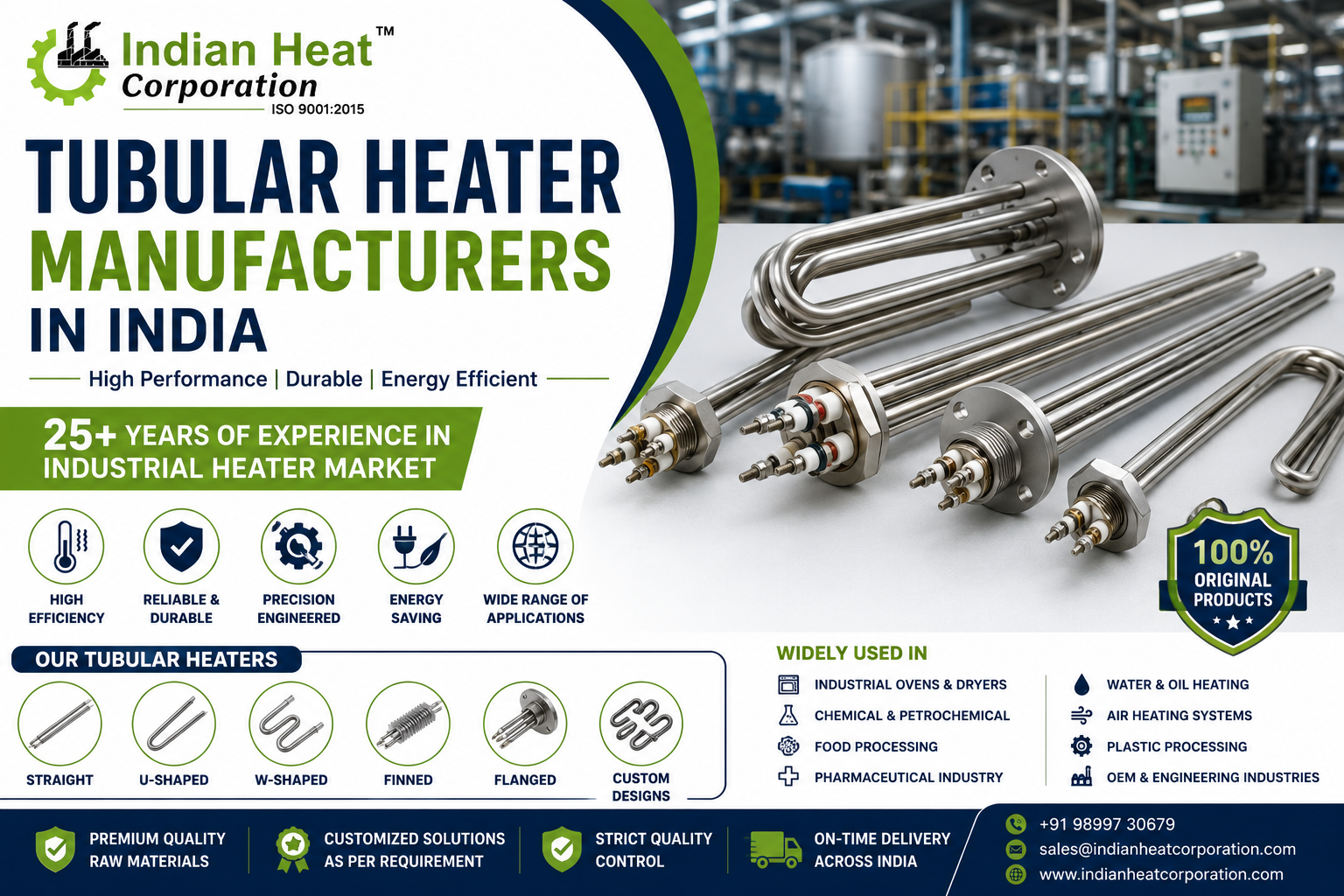
Industrial heating plays a critical role in modern manufacturing, from heating water, oil, and chemicals to maintaining precise temperatures inside industrial ovens, dryers, tanks, ducts, and processing equipment. Among the various industrial heating technologies available today, tubular heaters are widely preferred because of their versatility, durability, compact construction, and ability to efficiently transfer heat to air, liquids, and solid surfaces.
Indian Heat Corporation is a trusted tubular heater manufacturer in India, providing high-quality industrial tubular heating elements and customized heating solutions for a wide range of industrial applications. With 25+ years of experience in the industrial heater market, we understand the practical heating challenges faced by manufacturers, OEMs, engineering companies, and process industries.
We focus on supplying genuine industrial heating products and 100% original products, manufactured and sourced with an emphasis on quality, performance, and long-term reliability.
Whether you need a standard tubular heating element or a customized heater designed according to specific voltage, wattage, dimensions, sheath material, shape, or operating conditions, Indian Heat Corporation provides industrial heating solutions tailored to your application.
A tubular heater is an electric resistance heating element consisting of a resistance wire enclosed inside a metal sheath and electrically insulated using a high-quality insulating material such as magnesium oxide (MgO).
When electrical current passes through the resistance wire, electrical energy is converted into heat. The generated heat transfers through the insulation and outer metal sheath to the surrounding medium.
Depending on the heater design, tubular heating elements can be used for heating:
Air
Water
Oil
Chemicals
Gases
Metal surfaces
Industrial ovens
Process equipment
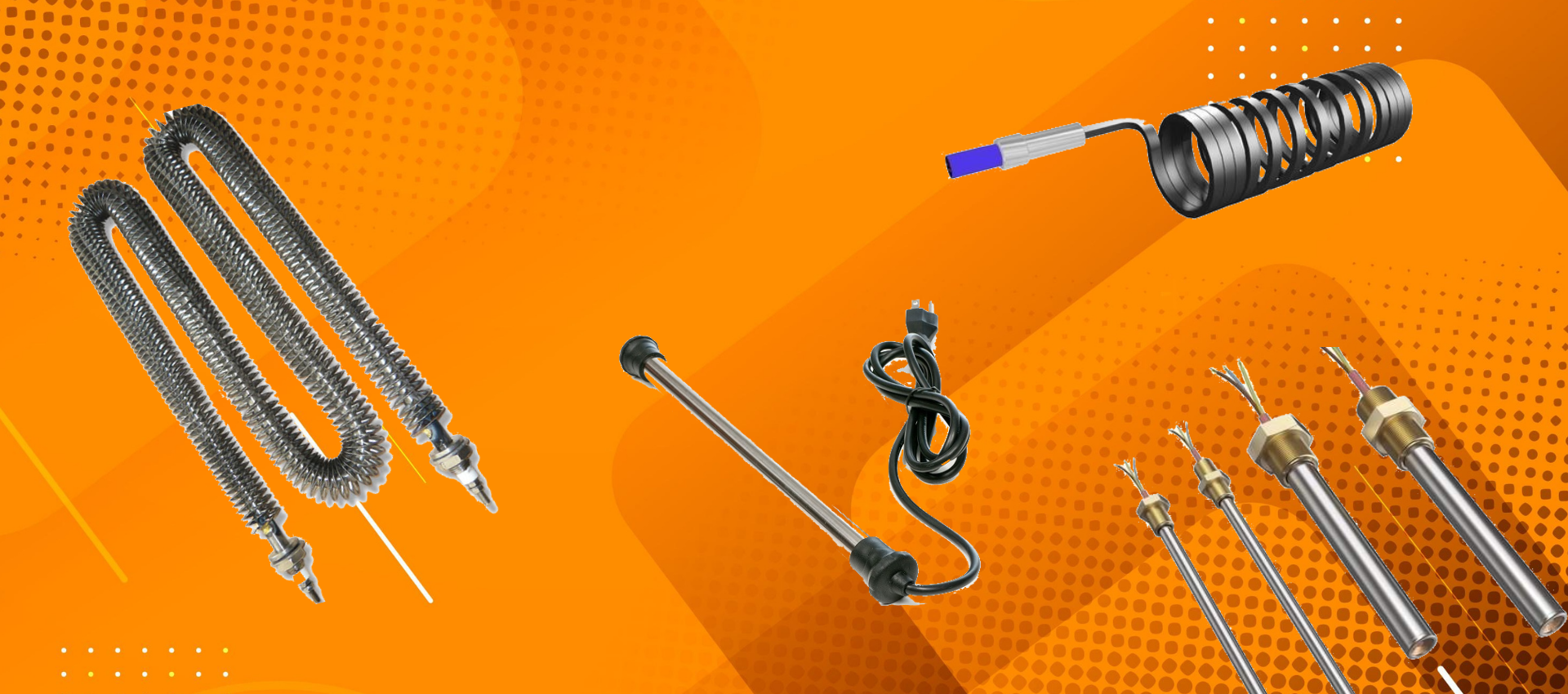
Tubular heaters can be manufactured in straight, U-shaped, W-shaped, circular, spiral, or customized configurations, making them suitable for diverse industrial heating applications.
The working principle of a tubular heater is based on electrical resistance heating, also known as Joule heating.
The process can be understood in four simple stages:
Electrical current flows through the internal resistance wire.
The resistance offered by the heating wire converts electrical energy into thermal energy.
The generated heat passes through the electrically insulating material surrounding the resistance wire.
The metal sheath transfers the generated heat to air, water, oil, chemicals, or the surface that needs to be heated.
The heater's performance depends on factors including watt density, sheath material, operating temperature, heating medium, airflow, liquid properties, and installation method.
Tubular heaters are among the most versatile industrial heating elements because a single basic heating technology can be adapted for numerous applications.
Major benefits include:
High thermal efficiency
Compact construction
Reliable heat transfer
Customizable shapes
Multiple sheath material options
Resistance to demanding operating environments
Suitable for air, liquid, and surface heating
Easy integration into industrial equipment
Different voltage and wattage options
Long operational life when correctly selected and installed
Their flexibility makes tubular heating elements suitable for both standalone industrial equipment and integrated OEM machinery.
Different industrial processes require different tubular heater designs. Choosing the correct type is essential for achieving efficient heat transfer and reliable operation.
Straight tubular heaters are one of the simplest configurations and are commonly used in industrial equipment where direct linear heating is required.
Industrial ovens
Heating plates
Air heating equipment
Drying machines
Industrial machinery
These heating elements are bent into a U-shaped configuration to provide increased heating surface within a compact installation area.
Water tanks
Industrial ovens
Air heating systems
Oil heating
Process equipment
W-shaped tubular heaters provide a larger heating surface and are commonly used when more heat output is required within a limited area.
Industrial ovens
Drying chambers
Heating equipment
Process machinery
Finned tubular heaters feature metal fins attached to the outer surface of the tubular element. The fins increase the effective surface area available for heat transfer.
They are primarily used for heating air and gases.
Industrial air heaters
HVAC systems
Drying equipment
Air ducts
Industrial ovens
Hot air systems
Increased heat-transfer surface
Effective air heating
Suitable for forced-air systems
Improved heat dissipation
Tubular elements can be configured into immersion heater assemblies for direct heating of compatible liquids.
Water heating
Oil heating
Industrial tanks
Process vessels
Cleaning equipment
The correct sheath material and watt density should always be selected according to the liquid being heated.
Some industrial machines require specialized heater geometries that cannot be achieved using standard designs.
Depending on manufacturing feasibility, tubular heaters can be customized into:
U shapes
W shapes
Circular shapes
Spiral configurations
Multiple-bend configurations
Custom heaters can be designed according to equipment dimensions and heating requirements.
A typical industrial tubular heating element consists of several important components.
The resistance wire generates heat when electrical current passes through it.
Common resistance heating alloys may include:
Nickel-Chromium (NiCr)
Iron-Chromium-Aluminium alloys
Material selection depends on the heater design and operating conditions.
High-grade magnesium oxide is commonly used to electrically isolate the resistance wire from the metallic outer sheath while supporting heat transfer.
The outer sheath protects the internal heating components and comes into direct or indirect contact with the heating environment.
Depending on the application, sheath materials may include:
Stainless Steel
Incoloy
Copper
Titanium
Other application-specific alloys
Electrical terminals connect the heating element to the power supply.
Terminal configurations can be customized depending on equipment design and installation requirements.
The following table provides general specification options. Final specifications should always be confirmed according to the actual industrial application.
| Technical Parameter | Available / Typical Options |
|---|---|
| Heater Type | Tubular Heating Element |
| Voltage | 110V, 220V, 230V, 240V, 380V, 415V, 440V or Custom |
| Phase | Single Phase / Three Phase, depending on assembly |
| Wattage | Customized according to application |
| Tube Diameter | Multiple standard and custom sizes |
| Heater Length | Customized |
| Shape | Straight, U, W, Circular or Custom |
| Sheath Material | SS304, SS316, Incoloy, Copper, Titanium or Application-Specific |
| Resistance Wire | NiCr or suitable resistance alloy |
| Insulation | High-grade Magnesium Oxide |
| Terminal Type | Threaded, Stud, Lead Wire or Custom |
| Temperature | Application and material dependent |
| Mounting | Custom brackets, threaded fittings, flanges or application-specific mounting |
| Temperature Sensor | Thermocouple / RTD integration where required |
| Customization | Voltage, Wattage, Shape, Size, Sheath and Termination |
Important: Technical specifications vary significantly according to the medium being heated, operating temperature, watt density, heater geometry, material compatibility, and environmental conditions. Consult the manufacturer before finalizing a heater for critical industrial applications.
Choosing the correct sheath material is one of the most important decisions when purchasing a tubular heater.
Stainless steel is widely used for general industrial applications because it provides a good balance between durability and corrosion resistance.
Common applications include:
Air heating
Industrial ovens
Food equipment
Process machinery
Water heating, depending on water chemistry
Incoloy alloys may be selected for demanding environments requiring improved oxidation or corrosion resistance.
Applications can include:
High-temperature process equipment
Industrial ovens
Air heating
Certain liquid heating applications
Copper provides excellent thermal conductivity and may be suitable for specific water-heating applications where material compatibility allows.
Titanium can be considered for certain highly corrosive liquid environments.
Applications may include:
Selected chemical solutions
Electroplating processes
Corrosive liquid heating
Material compatibility must always be verified before selecting titanium or any other sheath material.
Tubular heating elements are used across numerous industries because they can be adapted for different heating mediums.
Tubular heaters are commonly installed inside:
Drying ovens
Baking ovens
Curing ovens
Heat treatment equipment
Industrial chambers
Finned tubular heaters can be used to heat moving air in:
Air ducts
Dryers
HVAC equipment
Hot air systems
Industrial blowers
Appropriately designed tubular elements can be used for:
Industrial water tanks
Cleaning systems
Process water heating
Equipment washing systems
Low-watt-density tubular heating assemblies may be designed for suitable oil heating applications.
Correct watt density is particularly important because excessive surface temperatures may degrade certain oils.
Tubular heating elements can be used in selected chemical processing applications when the heater sheath material is chemically compatible with the process medium.
Applications may include:
Chemical tanks
Process vessels
Reactors
Cleaning systems
Indian Heat Corporation supplies industrial heating solutions suitable for applications across sectors such as:
Plastic Processing
Chemical Processing
Pharmaceutical Manufacturing
Food Processing
Packaging
Textile
Rubber
Printing
Automotive
Engineering
Electronics
Laboratory Equipment
Water Treatment
Industrial Machinery
OEM Equipment Manufacturing
Plastic manufacturing equipment requires controlled heating for processes involving extrusion, moulding, and material preparation.
Tubular heaters may be integrated into:
Plastic processing machinery
Dies
Moulds
Auxiliary equipment
Industrial ovens
The heater configuration depends on the equipment design and required temperature profile.
Chemical processing environments require careful heater selection because chemicals can react differently with heater sheath materials.
Before selecting a tubular heater, buyers should evaluate:
Chemical composition
Concentration
Operating temperature
Tank material
Required watt density
Corrosion potential
Operating pressure
A chemically incompatible heater may fail prematurely or create safety risks. Therefore, custom material selection is recommended for chemical applications.
Tubular heating elements can be incorporated into pharmaceutical processing and supporting equipment such as:
Industrial ovens
Dryers
Sterilization-related equipment
Process machinery
Laboratory equipment
Heater design should be selected according to applicable hygiene, process, and equipment requirements.
Industrial food equipment may use tubular heating elements for:
Baking
Drying
Cooking equipment
Hot air generation
Packaging machinery
Process water heating
Material selection should consider hygiene requirements, cleaning procedures, temperature, and contact conditions.
One of the most common applications of tubular heating elements is industrial air and oven heating.
Tubular and finned tubular heaters can provide controlled heat for:
Paint curing
Powder coating
Component drying
Moisture removal
Preheating
Industrial baking
Heat treatment
Heater placement and airflow design play an important role in achieving uniform oven temperatures.
Choosing a tubular heater based only on price can lead to poor heating performance, excessive power consumption, or premature heater failure.
Consider the following factors before purchasing:
Determine whether you need to heat:
Air
Water
Oil
Chemicals
Metal
Another process medium
The target temperature influences resistance wire, insulation, sheath material, and watt density selection.
Confirm the available electrical supply at your facility.
Wattage should be calculated based on factors such as:
Quantity or mass being heated
Temperature rise
Required heating time
Heat losses
Process conditions
Watt density is an important design parameter representing the heat output relative to the heater's active surface area.
Higher watt density is not always better.
Liquids such as oils and temperature-sensitive materials may require lower watt density to prevent localized overheating.
Choose a sheath material compatible with the operating environment.
The heater should fit correctly within the available installation space.
Depending on the process, consider using:
Thermostats
PID Controllers
Thermocouples
RTDs
Standard heaters are suitable when existing specifications match your equipment.
Custom tubular heaters are recommended when you require:
Special dimensions
Unique shapes
Specific voltage
Custom wattage
Special sheath material
Multiple heating zones
Special terminals
Sensor integration
Application-specific mounting
Indian Heat Corporation can work with customers to understand their application and develop a suitable customized heating solution.
Even a high-quality heater can fail prematurely if it is incorrectly selected or installed.
Common causes include:
Excessive watt density
Incorrect voltage
Poor heat dissipation
Chemical corrosion
Scale formation
Dry firing in liquid applications
Loose electrical connections
Moisture contamination
Mechanical damage
Operating above recommended temperatures
Correct product selection and preventive maintenance can significantly improve heater reliability.
Follow these practical recommendations:
Select the correct sheath material.
Use appropriate watt density.
Maintain proper electrical connections.
Avoid dry firing.
Prevent excessive scale accumulation.
Keep air heaters free from airflow restrictions.
Use suitable temperature controls.
Inspect heaters periodically.
Operate within the recommended temperature range.
Follow installation instructions.
Before placing an order, provide the manufacturer with as much technical information as possible.
Application
Heating medium
Required temperature
Starting temperature
Voltage
Required wattage
Heater dimensions
Preferred shape
Sheath material
Quantity
Terminal configuration
Mounting arrangement
Temperature sensor requirement
Operating environment
Drawing or sample, if available
Providing accurate application data allows the manufacturer to recommend a more suitable heater.
Choosing a dependable industrial heating partner is about more than simply purchasing a heating element. Product quality, technical understanding, material selection, customization, and after-sales support all influence long-term performance.
With more than 25 years of experience in the heater market, Indian Heat Corporation brings practical industry knowledge to industrial heating applications.
Our experience helps us understand the requirements of manufacturers, machine builders, OEMs, maintenance teams, and process industries.
We focus on building long-term business relationships by providing dependable products and transparent product specifications.
Indian Heat Corporation is committed to supplying 100% original products and genuine industrial heating solutions so customers can purchase with confidence.
We understand that industrial machinery often requires non-standard heaters. Depending on application requirements, we can provide customization based on:
Voltage
Wattage
Dimensions
Shape
Sheath material
Terminal configuration
Mounting
Sensor requirements
Selecting an industrial heater requires an understanding of operating conditions. Our team assists customers in identifying suitable heating solutions based on their specific requirements.
Our industrial heating solutions cater to a wide range of manufacturing and process industries.
Our focus remains on providing heating products designed for dependable operation, efficient heat transfer, and long-term industrial use.
Finding the right tubular heater manufacturer in India is particularly important when your application involves specialized temperatures, corrosive environments, continuous operation, or custom machinery.
Indian Heat Corporation provides tubular heating solutions for customers looking for standard as well as application-specific industrial heaters.
Whether you need tubular heaters for air heating, industrial ovens, dryers, water tanks, oil heating, chemical processing, or OEM machinery, our team can help you identify a suitable product based on your technical requirements.
A tubular heater is an electric resistance heating element consisting of a resistance wire electrically insulated inside a protective metal sheath. It converts electrical energy into heat and can be designed for heating air, liquids, or surfaces.
Tubular heaters are commonly used in industrial ovens, dryers, air ducts, tanks, process equipment, food machinery, pharmaceutical equipment, and other industrial heating applications.
There is no single best material for every application. Stainless steel, Incoloy, copper, and titanium may be used depending on operating temperature, corrosion conditions, heating medium, and other process requirements.
Yes. Tubular heaters can be customized based on voltage, wattage, length, diameter, shape, sheath material, terminals, mounting arrangement, and other application requirements.
A finned tubular heater is a tubular heating element with fins attached to its outer surface to increase heat-transfer area. It is primarily used for heating air and gases.
Yes. Appropriately designed tubular heating elements can be used for water heating. The sheath material and watt density should be selected according to water quality and operating conditions.
Yes, but oil heating typically requires careful watt-density selection to prevent excessive heater surface temperatures and degradation of the oil.
They can be used for certain chemical applications, provided the sheath material is compatible with the specific chemical, concentration, and operating temperature.
Tubular heaters can be manufactured for different voltage requirements depending on the application and electrical supply.
Required wattage depends on the amount of material being heated, desired temperature rise, heating time, heat losses, insulation, and operating conditions.
Watt density refers to the amount of electrical power generated relative to the active surface area of the heater. Selecting appropriate watt density is important for heater performance and service life.
Common causes include incorrect voltage, excessive watt density, overheating, poor heat transfer, corrosion, scale formation, dry firing, and loose electrical connections.
Provide details such as application, voltage, wattage, dimensions, shape, heating medium, operating temperature, sheath material, terminal requirements, and quantity. A sample or technical drawing can also help when replacing an existing heater.
Tubular heaters remain one of the most versatile and widely used industrial electric heating solutions because they can be engineered for air, liquid, and surface heating applications.
However, achieving reliable performance requires more than selecting a heater of the correct physical size. Factors such as wattage, watt density, operating temperature, sheath material, heating medium, voltage, heat transfer conditions, and installation method should all be considered before purchasing.
As an experienced tubular heater manufacturer in India, Indian Heat Corporation brings 25+ years of experience in the industrial heater market and provides standard and customized heating solutions for diverse industrial requirements.
With our focus on genuine supply, 100% original products, application-specific solutions, and dependable product quality, we aim to help manufacturers and industrial customers choose heating products that deliver efficient and reliable performance.
For custom tubular heater requirements, buyers should share complete technical specifications, operating conditions, or an existing heater sample so that the most suitable heating solution can be identified.
Looking for the best Hopper Heating Element Manufacturers in Kolkata?
Contact Indian Heat Corporation today for a free consultation and discover how our heating solutions can transform your operations.
📞 Call Now: +91-9891377270, 7982533957
📧 Email: info@indianheatcorporation.com
🌐 Website: www.indianheatcorporation.com