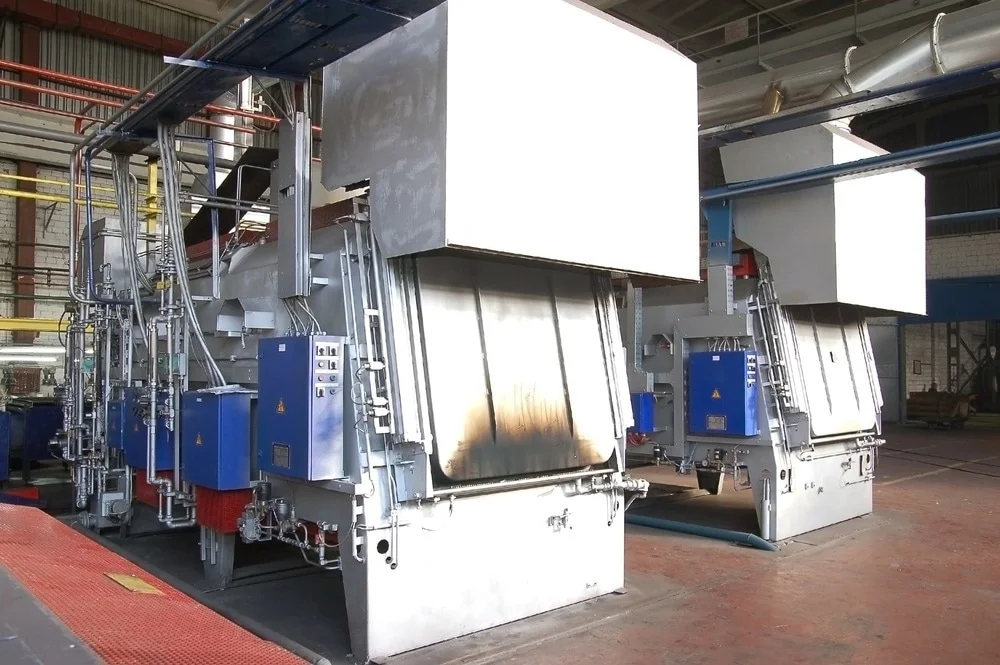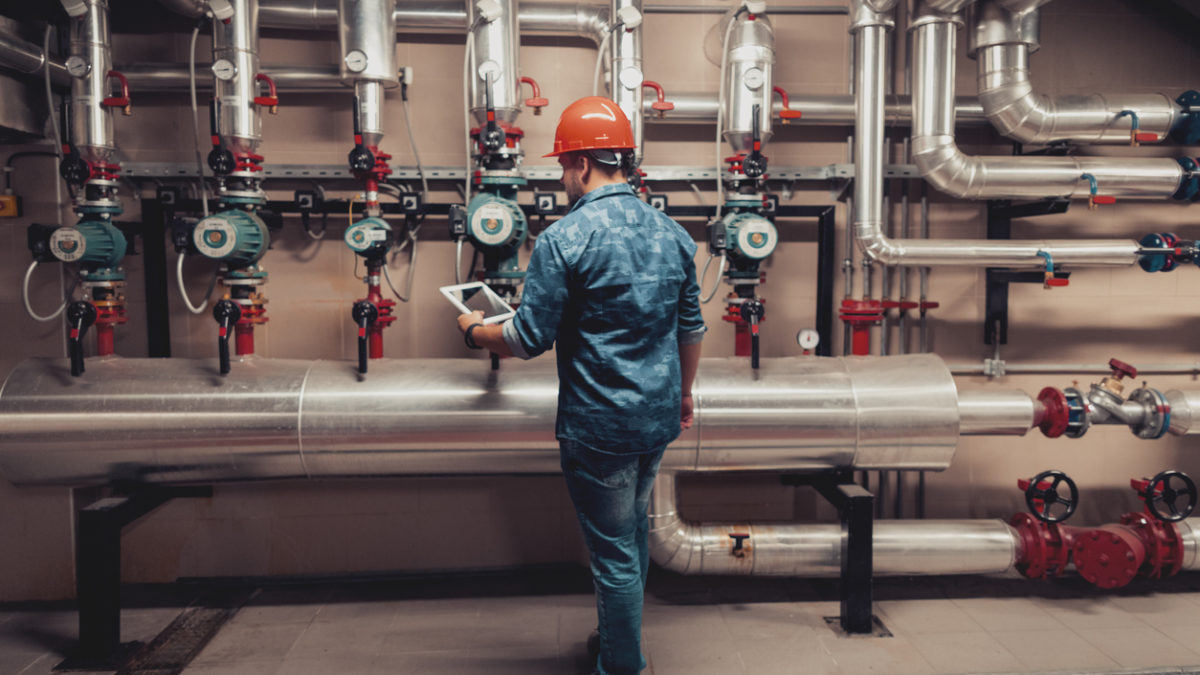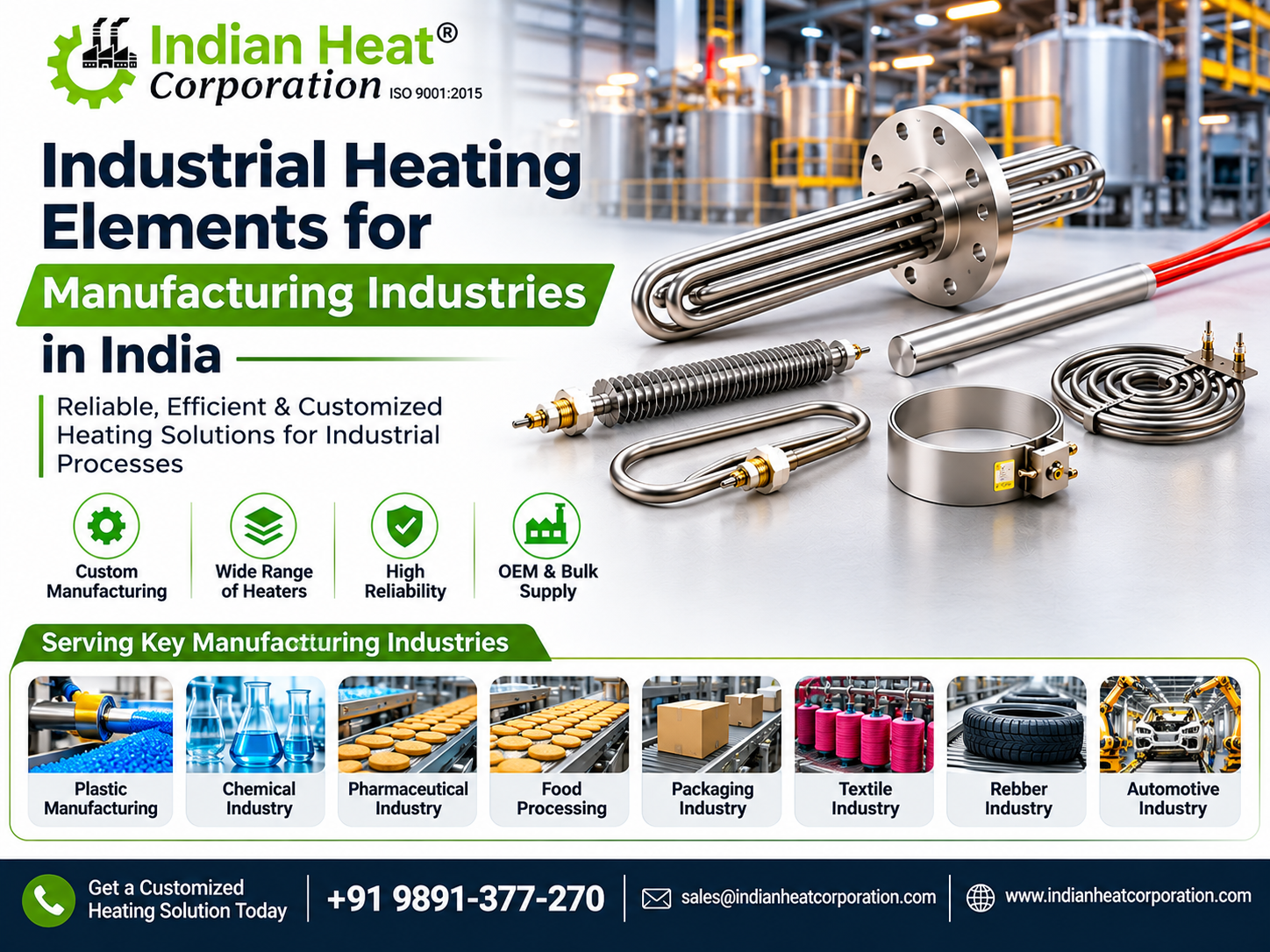
Indian Heat Corporation provides industrial heating elements and customized heating solutions for manufacturing industries across India. Industrial heating elements convert electrical energy into controlled heat for processes involving air, liquids, metal surfaces, moulds, dies, ovens, dryers, tanks and production machinery.
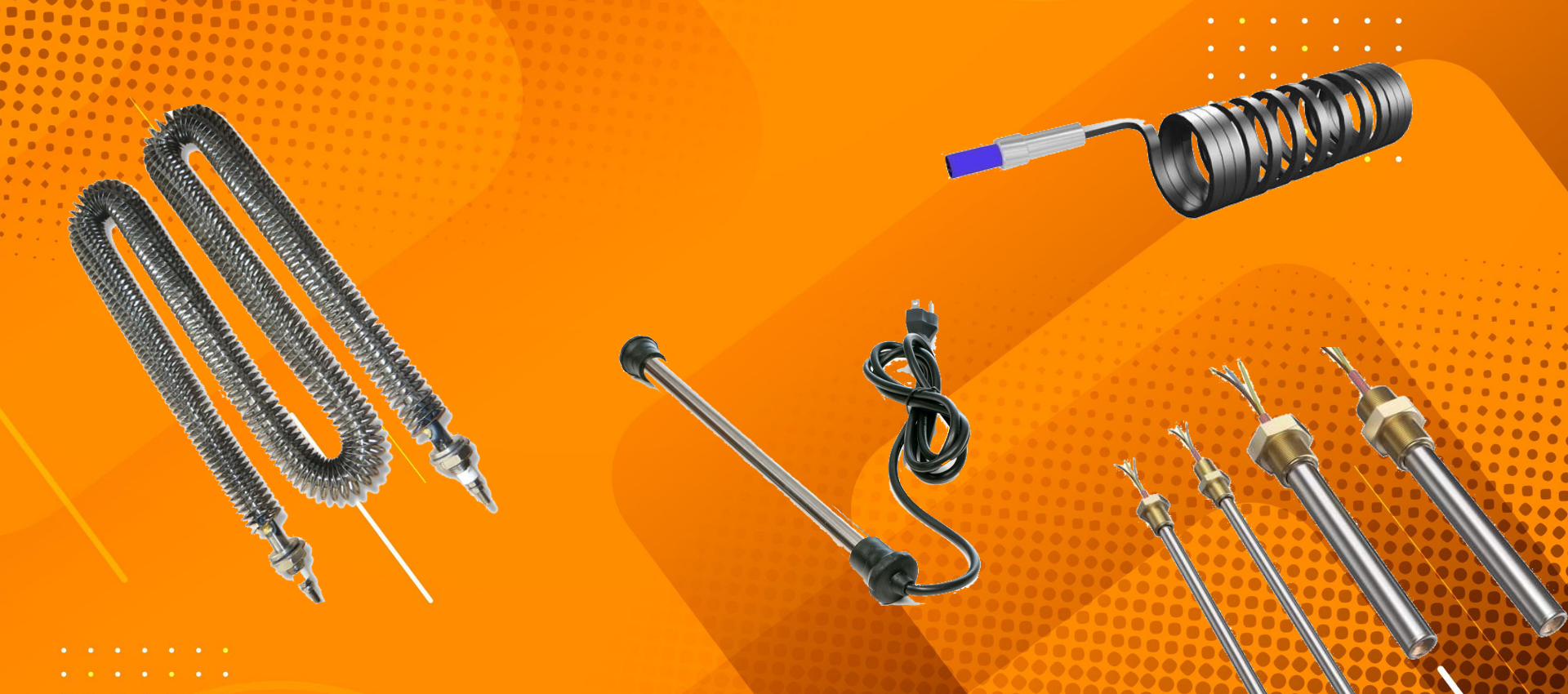
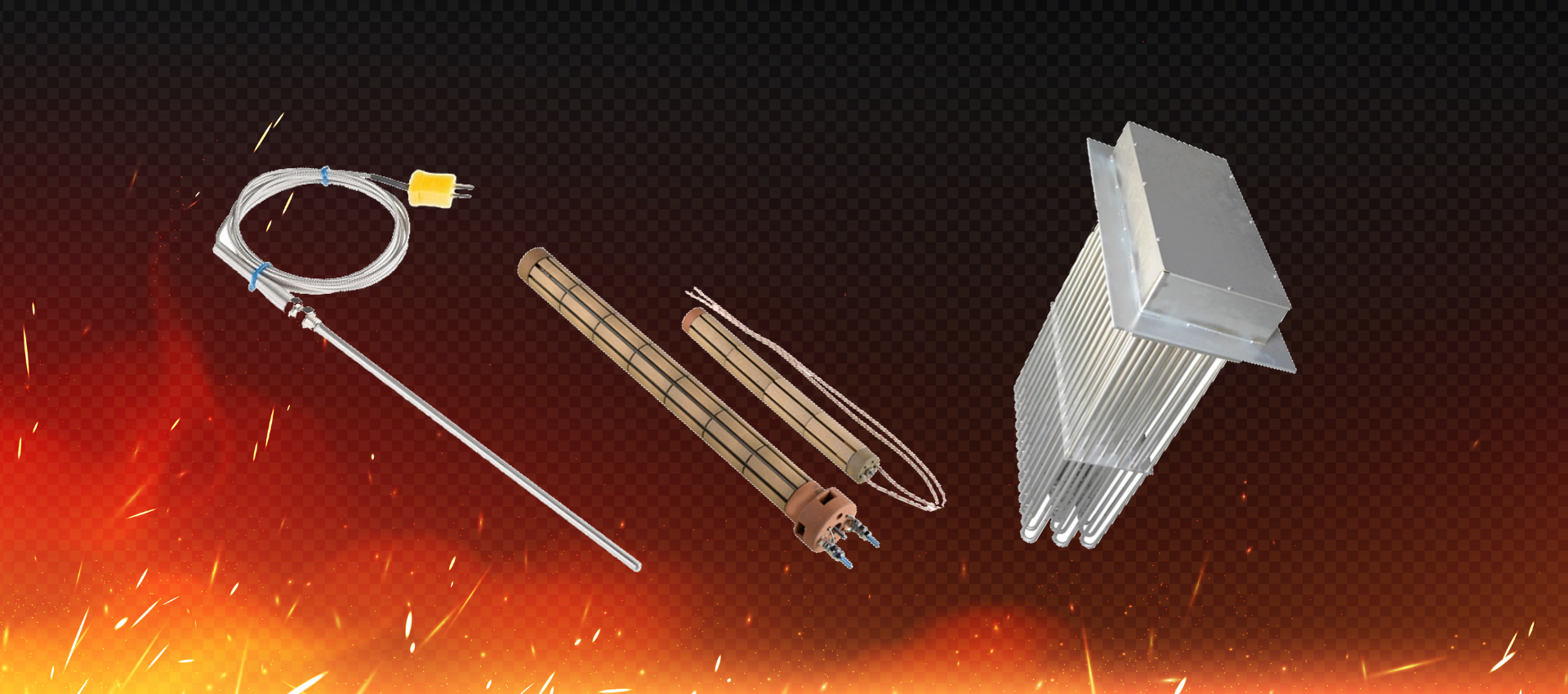
Plastic processing, chemical production, pharmaceuticals, food processing, packaging, textiles, automotive, rubber, steel and engineering industries use different types of electric heating elements. Common products include tubular heaters, cartridge heaters, mica band heaters, ceramic band heaters, immersion heaters, coil heaters, nozzle heaters, finned heaters, strip heaters, cast-in heaters, infrared heaters, quartz heaters and silicone rubber heaters.
Indian Heat Corporation supports industrial and OEM heating requirements with product options and customized configurations. Customers can share their application, dimensions, voltage, wattage, operating temperature, heating medium, quantity and drawing or sample photograph for technical evaluation.
Manufacturing industries use different electric heating elements according to the material being heated and the process involved. Tubular heaters are used in ovens, dryers and process equipment; cartridge heaters provide localized heating in dies and moulds; mica and ceramic band heaters heat cylindrical surfaces; immersion heaters heat compatible liquids; and finned tubular heaters are commonly used for air heating.
Coil and nozzle heaters are used in compact plastic-processing applications, strip heaters for flat surfaces, cast-in heaters for integrated metal blocks, and infrared or quartz heaters for radiant heating. Indian Heat Corporation offers industrial heating element solutions for manufacturing and OEM applications across India.
Industrial heating elements are electrical resistance components that convert electrical energy into thermal energy. When current passes through a resistance wire, heat is generated and transferred to a surrounding medium, surface or process material. Depending on the design, the element may heat air, water, oil, compatible chemicals, metal surfaces, plastic-processing equipment or industrial chambers.
Many tubular and cartridge heaters use a resistance wire surrounded by electrically insulating material, commonly compacted magnesium oxide (MgO), inside a metallic sheath. Other heater types use mica, ceramic, quartz, silicone rubber or specialized cast constructions. The heater must be selected for its intended operating conditions; a design suitable for heating air may not be suitable for direct liquid immersion or contact with a corrosive chemical.
Most electric resistance heaters operate through the following process:
Electrical Supply → Resistance Wire → Heat Generation → Heat Transfer → Controlled Industrial Process
Actual performance depends on heater construction, wattage, watt density, installation, heat-transfer conditions and temperature control.
The following heater types are commonly selected for different industrial applications. Final suitability depends on the equipment design and operating conditions.
Tubular heaters contain a resistance wire inside a metallic sheath with electrical insulation between the wire and sheath. They can be formed into straight, U-shaped, W-shaped, circular and application-specific configurations.
Features: Flexible shapes, multiple sheath material options, customized dimensions and suitability for air, liquid and surface-heating designs.
Applications: Industrial ovens, dryers, tanks, water heating, oil heating, air heaters and process equipment.
Design parameters: Voltage, wattage, tube diameter, length, shape, sheath material, insulation, terminal type, mounting and watt density are selected according to the application.
Cartridge heaters are cylindrical elements generally inserted into accurately sized drilled holes in metal blocks, dies, moulds, plates and machinery. They provide localized heating.
Features: Compact construction, localized heating, customized diameter and length, and different terminal and lead arrangements.
Applications: Plastic injection moulding, extrusion equipment, dies, moulds, hot runner systems, packaging machinery and industrial tooling.
Mica band heaters heat cylindrical surfaces such as barrels, pipes and nozzles. A resistance wire is insulated with mica and enclosed in a metal casing.
Features: Band-style construction, application-specific diameter and width, replaceable design and different terminal configurations.
Applications: Plastic injection moulding machines, extruders, blow moulding equipment and cylindrical processing machinery.
Ceramic band heaters use ceramic insulating components to support the resistance wire. They are considered for cylindrical heating applications where the operating temperature and thermal insulation requirements suit this construction.
Applications: Plastic extrusion, injection moulding, blow moulding and industrial barrel heating.
Immersion heaters transfer heat directly into a liquid and may be installed through threaded or flanged connections.
Features: Direct liquid heating, different mounting arrangements, customized wattage and sheath material selection.
Applications: Water tanks, oil tanks, compatible chemical solutions, process vessels and industrial liquid-heating systems. Sheath compatibility and watt density are especially important for corrosive liquids and viscous fluids.
Coil heaters are compact elements used where concentrated heat is required in a limited space. Nozzle heaters are specialized assemblies used around plastic processing nozzles; designs may use mica, ceramic or coil-based constructions.
Applications: Hot runner systems, injection moulding nozzles, extrusion equipment and compact industrial machinery.
Finned tubular heaters have metallic fins attached to the tubular sheath to increase the available heat-transfer surface. They are commonly considered for forced-air heating systems.
Applications: Industrial air heaters, duct heaters, HVAC equipment, drying ovens, ventilation systems and air circulation equipment.
Strip heaters are flat or rectangular heating elements designed to transfer heat to a surface or machine component.
Applications: Heat sealing equipment, packaging machinery, metal plates, dies, moulds and flat-surface heating.
Cast-in heaters are integrated into a cast metal body, commonly aluminium, to distribute heat across a larger surface or machine component.
Applications: Plastic extrusion machinery, heated platens, moulding equipment and specialized industrial machinery.
Infrared heaters transfer energy by radiation and can be used where direct radiant heating is beneficial. Quartz heating elements use quartz tubes or envelopes in radiant-heating designs.
Applications: Paint curing, drying, thermoforming, printing, packaging, surface heating and selected industrial oven processes.
Silicone rubber heaters are flexible heating solutions that can be made to fit selected surfaces, containers and equipment.
Applications: Drums, tanks, containers, laboratory equipment, battery heating and specialized machinery.
Each manufacturing sector has distinct heating requirements. Heater selection should consider the process material, temperature range, heating cycle, production environment and equipment design.
Plastic processing uses controlled heating for melting, extrusion, moulding and material forming.
Applications: Injection moulding, plastic extrusion, blow moulding, PVC pipe production, thermoforming and hot runner systems.
Common heater choices: Mica band heaters, ceramic band heaters, cartridge heaters, coil heaters, nozzle heaters and cast-in heaters.
Chemical plants use heating for mixing, temperature maintenance, process vessels, liquid transfer and selected drying operations.
Applications: Chemical tanks, process vessels, heating baths, water treatment systems and compatible process-fluid heating.
Common heater choices: Immersion heaters, flanged heaters, tubular heaters and circulation heaters. The sheath material must be checked against the exact chemical, concentration and operating temperature.
Pharmaceutical equipment may require controlled and repeatable heating for drying, process operations and laboratory applications.
Applications: Drying equipment, process vessels, sterilization systems, laboratory equipment and fluid-bed dryers.
Common heater choices: Tubular heaters, cartridge heaters, air heaters and application-specific oven heaters.
Food manufacturing uses heating for drying, baking, cooking, process water and packaging operations.
Applications: Food dryers, industrial ovens, baking equipment, dairy processing and packaging machinery.
Common heater choices: Tubular heaters, immersion heaters, air heaters, infrared heaters and quartz heaters. Equipment hygiene and applicable material requirements must be considered.
Packaging lines use heat for sealing, shrink wrapping, lamination and drying.
Applications: Heat sealing, shrink packaging, blister packaging, lamination and flexible packaging machinery.
Common heater choices: Cartridge heaters, strip heaters, coil heaters, nozzle heaters and infrared heaters.
Textile manufacturing uses controlled heat for drying, printing, finishing and heat-setting processes.
Applications: Textile dryers, fabric processing, heat-setting machinery and textile printing.
Common heater choices: Finned tubular heaters, air heaters, infrared heaters, quartz heaters and tubular elements.
Rubber processing uses heating during moulding, extrusion and vulcanization-related operations.
Common heater choices: Cartridge heaters, tubular heaters, band heaters and cast-in heaters, depending on the machine design.
Automotive production may use heating for paint curing, component drying, plastic moulding and finishing processes.
Common heater choices: Infrared heaters, tubular heaters, cartridge heaters, air heaters and oven heating elements.
Metal processing can involve heat treatment, drying, annealing and other high-temperature operations.
Common heater choices: Specialized furnace heating elements, suitable tubular heaters and industrial air-heating systems. Selection depends on furnace atmosphere, temperature and process conditions.
Glass and ceramics production involves controlled drying, firing and high-temperature processing.
Common heater choices: Quartz heaters, ceramic heating elements and specialized furnace heating systems.
Printing and paper equipment may require heat for ink drying, coating, lamination and material finishing.
Common heater choices: Infrared heaters, quartz heaters, tubular heaters and finned air heaters.
Electronics production may require localized or controlled heating for component assembly, testing and specialized equipment.
Common heater choices: Cartridge heaters, coil heaters, silicone rubber heaters and application-specific tubular heaters.
Water treatment facilities may use heating for process tanks, selected chemical solutions and temperature-controlled operations.
Common heater choices: Immersion heaters, flanged heaters and tubular heating elements, subject to water quality and chemical compatibility.
Oil and petrochemical facilities may require heating for process fluids, tanks and pipelines. Heater design must account for fluid properties, temperature, hazardous-area classification and installation conditions.
Common heater choices: Immersion heaters, flanged heaters, circulation heaters and specialized tubular heating systems.
Industrial heating elements are specified according to electrical, mechanical and thermal requirements. Exact values should be finalized for the intended application rather than assumed from a generic product range.
| Parameter | What to Specify |
|---|---|
| Voltage | Available electrical supply and phase |
| Wattage | Required heating power based on process calculations |
| Watt Density | Power per unit of active heating surface |
| Dimensions | Length, diameter, width and available installation space |
| Shape | Straight, U, W, circular, band, coil or custom |
| Sheath Material | SS304, SS316, Incoloy, titanium, copper or other suitable material |
| Insulation | MgO, mica, ceramic, silicone or design-specific insulation |
| Heating Wire | Nickel-chromium or another suitable resistance alloy |
| Terminal | Lead wire, screw, ceramic terminal or custom connection |
| Mounting | Threaded, flanged, clamp, inserted or surface-mounted |
| Temperature | Process temperature and heater operating limits |
| Sensor Provision | Thermocouple, RTD or external temperature-control arrangement |
Important: Final specifications should be confirmed against the heating medium, process temperature, electrical supply, dimensions, heat-up time, heat losses and installation conditions.
There is no single material that is best for every heater. The sheath and insulation should be selected according to temperature, corrosion exposure, oxidation, mechanical requirements and the medium being heated.
| Material | General Characteristics | Potential Applications |
|---|---|---|
| SS304 | General-purpose stainless steel option | General industrial heating and suitable water or air applications |
| SS316 | Improved resistance to many corrosive environments compared with SS304 | Selected chemical and liquid heating applications |
| Incoloy alloys | Selected grades offer high-temperature and oxidation resistance | Industrial ovens and demanding heating environments |
| Titanium | Resistant to many specific corrosive media | Selected chemical and electroplating applications |
| Copper | High thermal conductivity | Suitable water and heat-transfer applications |
Compatibility must be checked against the exact chemical composition, concentration, temperature and operating conditions. Material names alone do not establish suitability.
| Heater Type | Typical Use | Key Selection Consideration |
|---|---|---|
| Tubular Heater | Ovens, tanks, dryers and process heating | Shape, sheath, watt density and heat-transfer medium |
| Cartridge Heater | Dies, moulds and localized heating | Hole fit, insertion length and heat distribution |
| Mica Band Heater | Plastic barrels and cylindrical surfaces | Barrel fit, contact and operating temperature |
| Ceramic Band Heater | Selected higher-temperature cylindrical applications | Insulation design and operating conditions |
| Immersion Heater | Direct liquid heating | Liquid compatibility, watt density and liquid level |
| Coil / Nozzle Heater | Compact nozzles and hot runner systems | Available space and localized heat requirement |
| Finned Heater | Air and duct heating | Airflow, fin design and temperature rise |
| Infrared / Quartz Heater | Radiant heating and surface drying | Distance, target material and radiant absorption |
| Strip Heater | Flat surfaces and sealing equipment | Surface contact and mounting arrangement |
| Silicone Rubber Heater | Flexible surface heating | Surface compatibility and attachment method |
The most suitable heater is determined by the application, not simply by the product name or purchase price.
Before ordering an industrial heater, evaluate the following points:
Confirm whether the heater will heat air, water, oil, a chemical solution, a metal surface, plastic material or another process medium.
Specify the starting temperature, target process temperature, maximum allowable temperature and required heat-up time.
For a basic sensible-heat estimate, use: Power (W) = [Mass (kg) × Specific Heat (J/kg°C) × Temperature Rise (°C)] ÷ Heating Time (seconds). Additional power is required to account for heat losses. Phase changes and evaporation require further energy calculations.
Watt density is the electrical power generated per unit of active heating surface. Excessive watt density can cause localized overheating, deposits or premature failure. The appropriate value depends on the medium and heat-transfer conditions.
Consider corrosion resistance, operating temperature, oxidation, mechanical strength and chemical compatibility.
Specify voltage, phase, wattage, current, terminal arrangement and required electrical protection.
Provide the length, diameter, width, shape, active heating zone, cold zone, terminal position and mounting dimensions.
Determine whether a thermostat, thermocouple, RTD or external temperature controller is needed.
Check available installation space, accessibility, airflow or liquid circulation, electrical connections and maintenance requirements.
Choose a manufacturer that can review your process details, material requirements and technical specifications before confirming the heater design.
| Problem | Possible Cause | Recommended Check |
|---|---|---|
| Heater burnout | Excessive temperature, unsuitable watt density or poor heat transfer | Review design, operating conditions and temperature control |
| Slow heating | Insufficient wattage or high heat losses | Recalculate heat requirement and insulation losses |
| Electrical leakage | Insulation damage or moisture ingress | Inspect and test insulation before operation |
| Corrosion | Unsuitable sheath material | Verify compatibility with the process medium |
| Uneven heating | Poor placement or uneven heat transfer | Review heater positioning and process circulation |
| Frequent failure | Incorrect voltage, installation or operating cycle | Verify electrical and thermal specifications |
| Scaling | Deposits from the heated liquid | Use suitable water treatment and maintenance practices |
Indian Heat Corporation provides industrial heating elements and customized heating solutions for manufacturing, machinery and OEM applications. Customers can discuss their process requirements and share technical details for product evaluation.
Product requirements may include tubular, cartridge, mica band, ceramic band, immersion, coil, nozzle, finned, strip, cast-in, infrared, quartz and silicone rubber heating elements.
Heater designs can be evaluated for required voltage, wattage, dimensions, shape, sheath material, terminal arrangement, mounting and application-specific features.
Heating solutions are relevant to plastic, chemical, pharmaceutical, food processing, packaging, textile, rubber, automotive, metal, glass, electronics and engineering sectors.
Customers can share machine drawings, dimensions, sample photographs or an existing heater to discuss a new or replacement heating element.
Providing the heating medium, temperature, electrical supply and installation details helps identify a suitable heater configuration.
Indian Heat Corporation is based in Delhi, India, and serves industrial heating requirements from customers across different Indian manufacturing markets. Confirm product availability and delivery timelines with the company.
Indian Heat Corporation receives industrial heating enquiries from major manufacturing and industrial markets across India, including:
For large projects, customized orders and OEM requirements, confirm product specifications, availability and delivery schedules directly with the company.
Industrial heating elements are electrical resistance components that convert electrical energy into heat for manufacturing processes such as drying, moulding, liquid heating, air heating and surface heating.
Common types include tubular, cartridge, mica band, ceramic band, immersion, coil, nozzle, finned, strip, cast-in, infrared, quartz and silicone rubber heaters.
There is no single best heater for every industry. Tubular heaters suit many oven and process applications, cartridge heaters suit localized heating, band heaters suit cylindrical surfaces and immersion heaters suit compatible liquid heating.
Mica band, ceramic band, cartridge, coil and nozzle heaters are commonly used in plastic injection moulding, extrusion and related processing equipment.
Immersion, flanged, tubular and circulation heaters may be used. The sheath and wetted materials must be compatible with the exact chemical, concentration and operating conditions.
Tubular heaters are used in a wide range of air, liquid and surface-heating designs. Cartridge heaters are generally inserted into drilled holes to provide localized heating in dies, moulds and metal blocks.
Mica band heaters use mica insulation and are used in many standard cylindrical heating applications. Ceramic band heaters use ceramic insulation and may be selected for different temperature and thermal-insulation requirements.
SS304, SS316, Incoloy alloys, titanium and copper each have different properties. Selection depends on the heating medium, temperature, corrosion exposure and mechanical requirements.
A basic estimate uses the material mass, specific heat, temperature rise and heating time. Heat losses and any phase change must also be included for a suitable design.
Watt density is the electrical power generated per unit of active heating surface area. It affects heater surface temperature and must be matched to the medium and heat-transfer conditions.
Yes. Depending on the heater type, dimensions, shape, voltage, wattage, sheath material, terminal arrangement and mounting can be specified for the application.
Possible causes include excessive watt density, overheating, incorrect voltage, poor heat transfer, unsuitable material, dry operation of immersion heaters and inadequate temperature control.
Tubular heaters are commonly used in industrial ovens. Finned tubular elements may be appropriate in forced-air systems. Selection depends on chamber size, airflow, temperature and heat-up requirements.
Immersion and suitably designed tubular heaters are used for liquid heating. Material compatibility, liquid level, watt density and installation must be evaluated.
Finned tubular elements and purpose-designed duct or air heaters are commonly used for forced-air heating and drying applications.
Use the correct voltage and wattage, select compatible materials, maintain suitable temperature control, avoid operation outside design limits and follow appropriate inspection and cleaning procedures.
Share the heater type, application, voltage, wattage, dimensions, material, target temperature, quantity, mounting details and any available drawing or sample photograph.
Indian Heat Corporation is based in Delhi and handles industrial heating enquiries from customers across India. Confirm product availability and delivery details directly with the company.
Looking for industrial heating elements for your manufacturing plant, production machinery or OEM equipment? Contact Indian Heat Corporation to discuss your application and technical requirements.
To help evaluate your requirement, share:
Company: Indian Heat Corporation
Products: Industrial Heating Elements and Customized Industrial Heaters
Location: Delhi, India
Service Coverage: Pan-India industrial enquiries
Call / WhatsApp: +91 9891-377-270 / +91 7982-533-957
Email: info@indianheatcorporation.com
Website: Indian Heat Corporation
Request a Customized Heating Solution: Share your application, voltage, wattage, dimensions, operating temperature and required quantity with Indian Heat Corporation for a product recommendation and quotation.
Industrial heating elements are essential components in manufacturing processes that require controlled and repeatable heat. Tubular, cartridge, band, immersion, coil, finned, strip, cast-in, infrared, quartz and flexible heaters each serve different applications.
The right selection depends on the heating medium, process temperature, required wattage, watt density, material compatibility, electrical supply, dimensions and installation conditions. Evaluating these parameters before ordering can help improve process performance and reduce avoidable heater failures.
Indian Heat Corporation provides industrial heating elements and customized heating solutions for manufacturing and OEM applications. Contact the team with your technical requirements to discuss a suitable industrial heating solution.