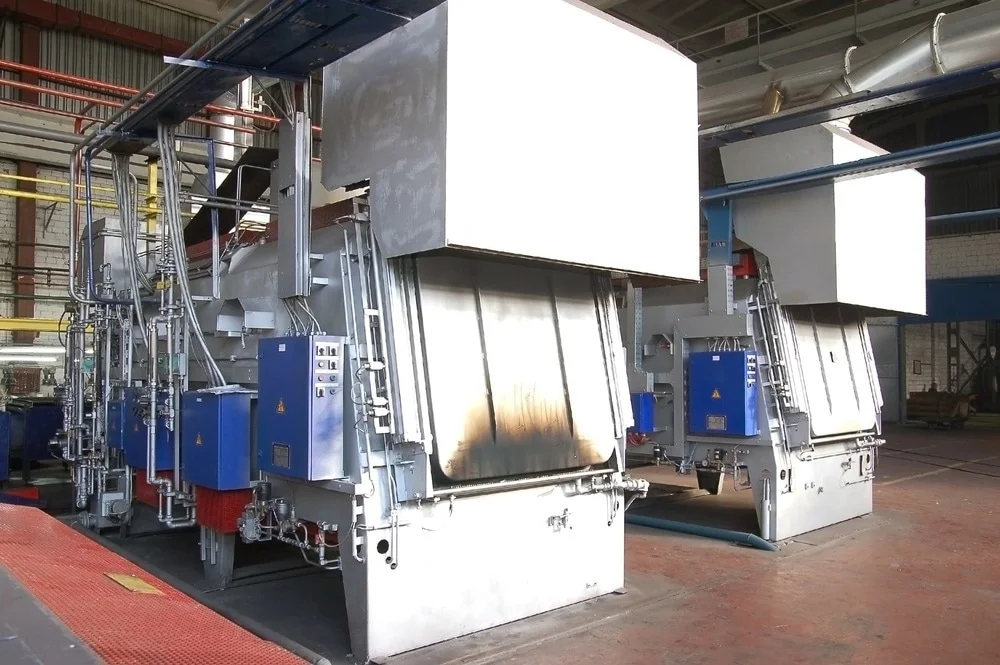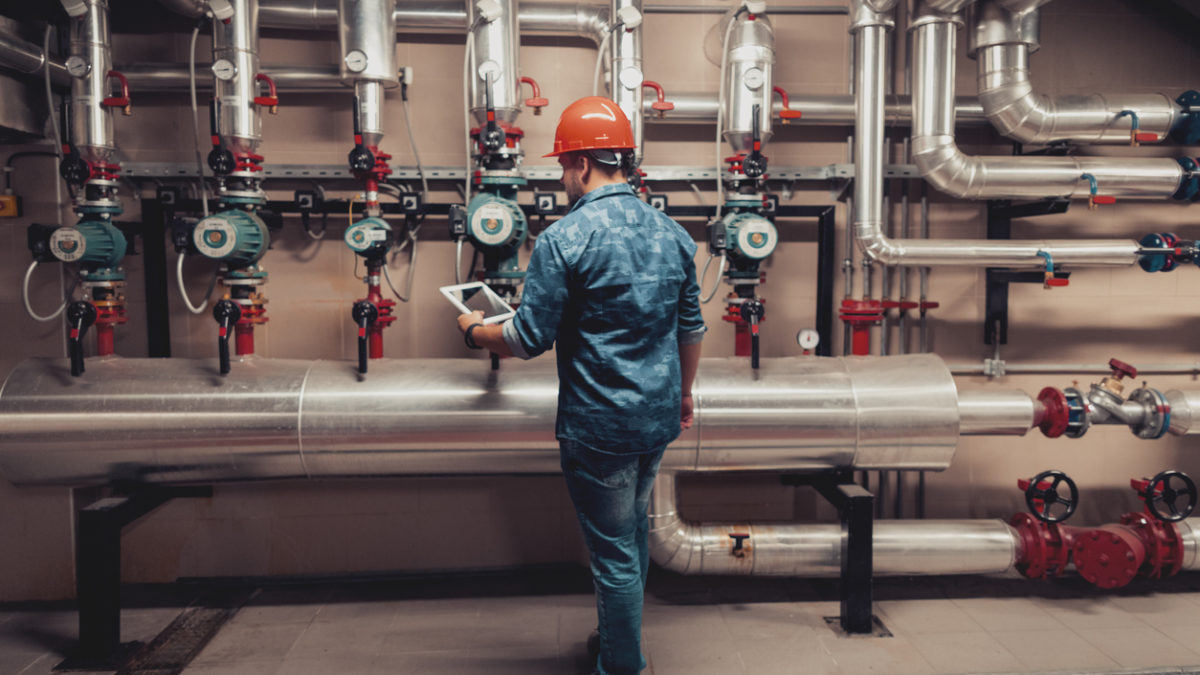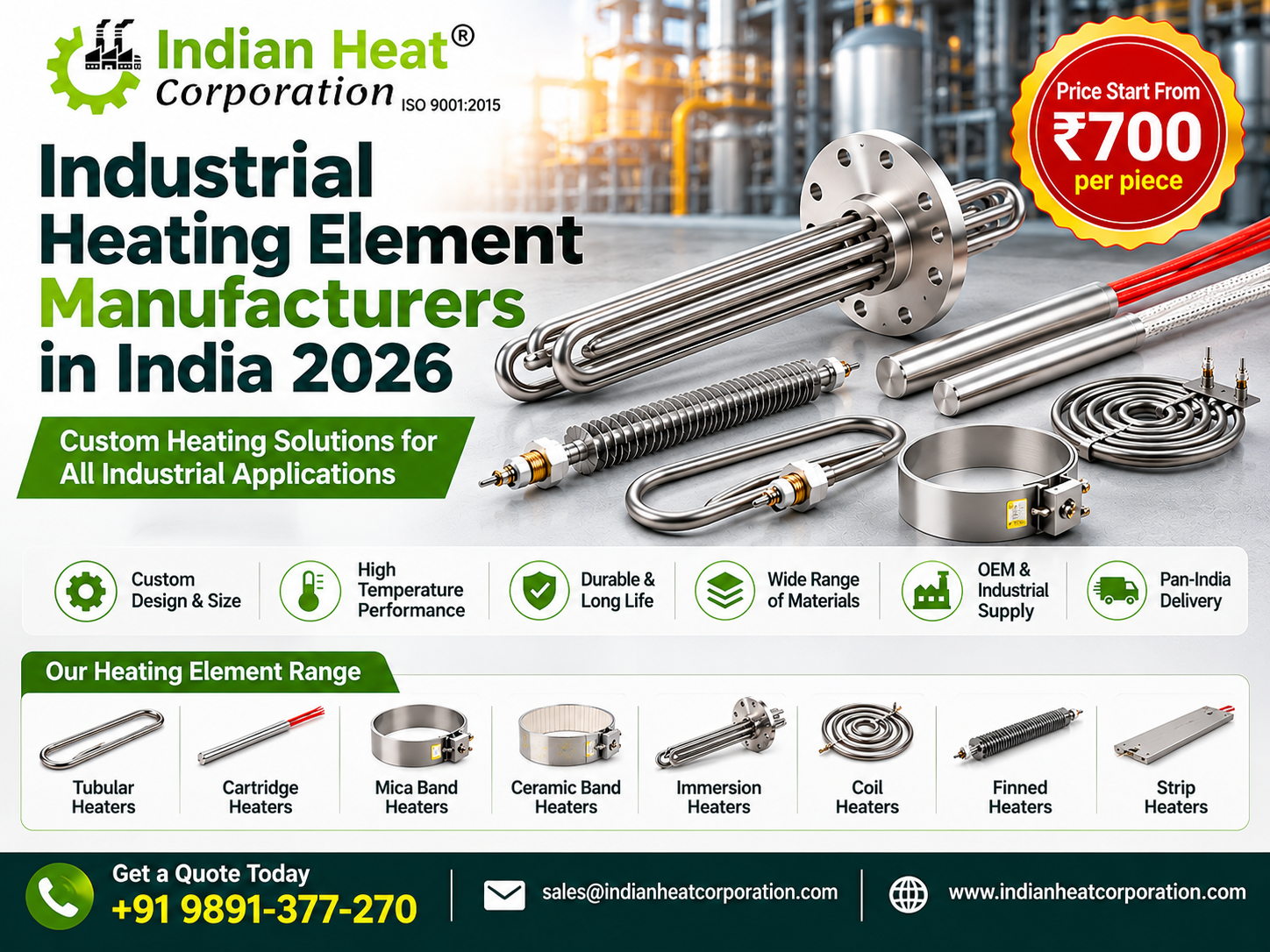
Industrial heating element manufacturers in India design and manufacture electric heating elements that convert electrical energy into heat for industrial processes. These heating elements are used in factories, production machinery, ovens, dryers, tanks, moulds, dies, air systems and process equipment across sectors such as plastic processing, chemicals, pharmaceuticals, food processing, packaging, textiles, automotive and engineering.
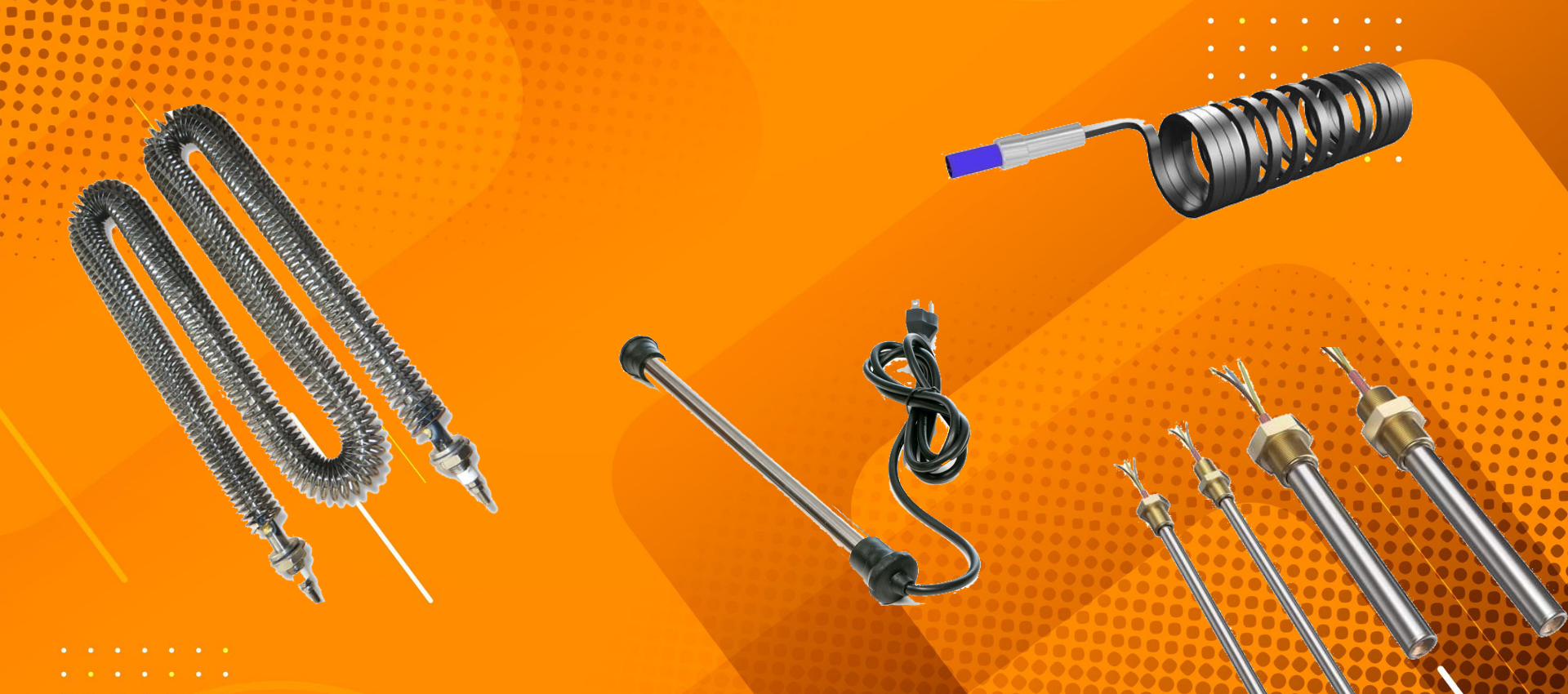
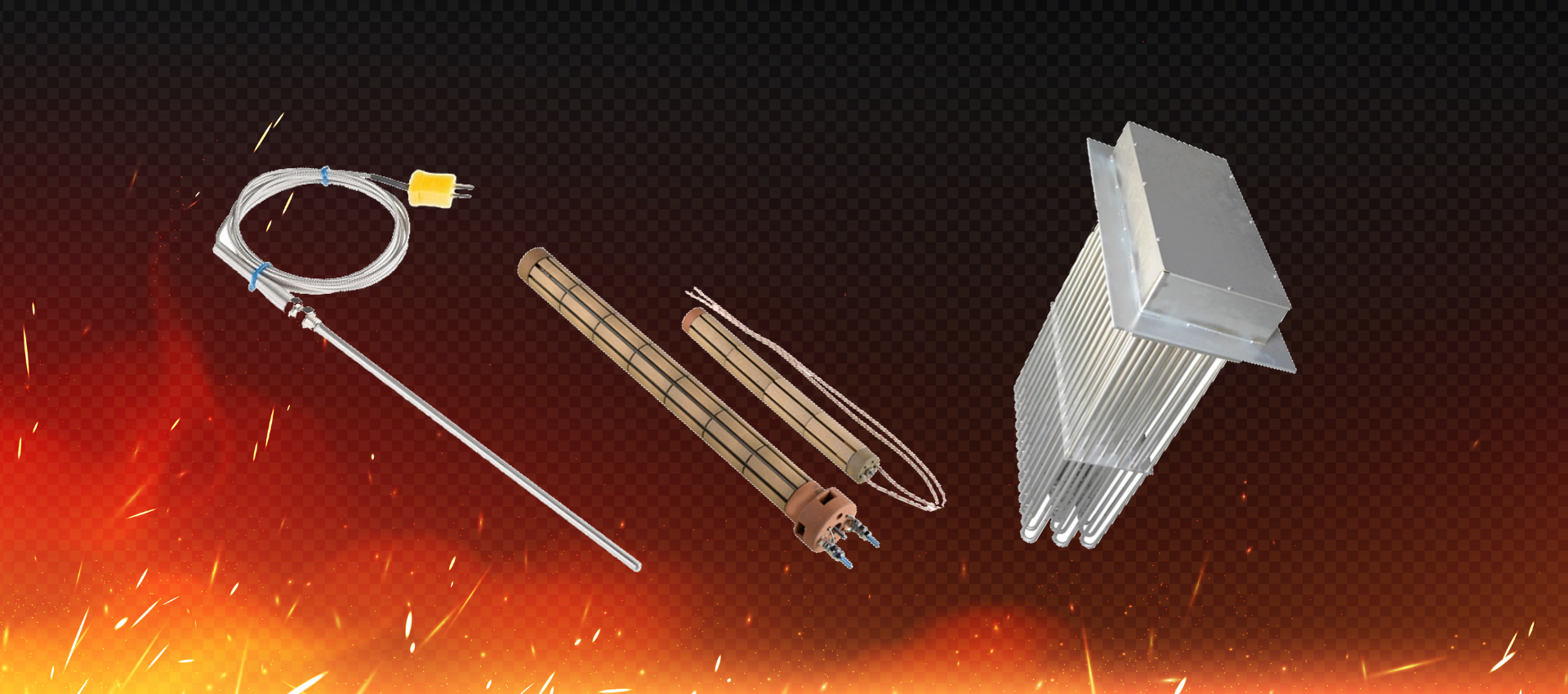
Indian Heat Corporation, based in Delhi, India, offers industrial heating elements and customized heating solutions for different industrial and OEM applications. The product range includes tubular heaters, cartridge heaters, mica band heaters, ceramic band heaters, immersion heaters, coil heaters, nozzle heaters, finned heaters, strip heaters, cast-in heaters, infrared heaters, quartz heaters, silicone rubber heaters and industrial air heaters.
This 2026 guide explains industrial heating element types, working principles, technical specifications, materials, industry applications, product comparisons, customization options and the key factors to consider when choosing an industrial heating element manufacturer in India.
Industrial heating element manufacturers in India produce electric resistance heaters for controlled heating of liquids, air, gases, metal surfaces, machinery and industrial processes. Products are selected according to application, voltage, wattage, dimensions, sheath material, temperature, watt density and installation requirements.
Indian Heat Corporation is an industrial heating solutions company based in Delhi, India, offering a range of industrial heating elements and customized heater options for manufacturing companies, OEMs, machinery builders and process industries across India.
Indian Heat Corporation provides industrial heating products and application-based heating solutions for industrial machinery, process equipment, manufacturing plants and specialized OEM requirements. Customers can discuss standard or customized heating requirements based on the operating environment and equipment specifications.
The product range covers heating solutions for liquid heating, air heating, surface heating, cylindrical heating, mould and die heating, drying, curing and industrial process applications.
| Product | Typical Applications |
|---|---|
| Tubular Heaters | Ovens, dryers, tanks, air and process heating |
| Cartridge Heaters | Moulds, dies, hot runner systems and precision heating |
| Mica Band Heaters | Plastic barrels and extrusion machinery |
| Ceramic Band Heaters | Cylindrical barrel heating applications |
| Immersion Heaters | Water, oil and compatible liquid heating |
| Coil and Nozzle Heaters | Nozzles, hot runners and compact heating zones |
| Finned Tubular Heaters | Industrial air ducts, dryers and ovens |
| Strip Heaters | Plates, dies and surface heating |
| Cast-In Heaters | Extrusion and industrial machinery |
| Infrared and Quartz Heaters | Radiant heating, drying and curing |
| Silicone Rubber Heaters | Flexible surface and tank heating |
| Industrial Air Heaters | Air handling, ventilation and drying systems |
Industrial heating elements are electrical components that generate heat through electrical resistance. When current passes through a resistance conductor, electrical energy is converted into thermal energy. The heat is then transferred to the required medium or surface through a sheath, insulation assembly, radiant surface or direct-contact arrangement, depending on the heater design.
Industrial heating elements are used for heating water, oil, compatible chemical solutions, air, gases, metal surfaces, moulds, dies, ovens, dryers, tanks and process equipment. Their construction and material selection depend on the operating temperature, heating medium, electrical supply, installation method and process conditions.
Most industrial resistance heaters operate on the principle of Joule heating. Electrical current passes through a resistance wire and generates heat. In a mineral-insulated tubular heater, for example, the resistance wire is electrically separated from the outer metal sheath by compacted magnesium oxide insulation, which also conducts heat toward the sheath.
Electrical Supply → Resistance Wire → Heat Generation → Heat Transfer → Industrial Process
The generated heat may be transferred by conduction, convection or radiation. Temperature sensors and suitable control equipment can be used to monitor and regulate the process temperature.
Different heater designs are used for different industrial applications. The following sections describe common industrial heating element categories, their construction, features and typical uses.
Tubular heating elements contain a resistance wire inside a metallic sheath with electrical insulation between the wire and sheath. They can be formed into straight, U-shaped, W-shaped, circular and other application-specific configurations.
Features: flexible geometry, different sheath material options, customized dimensions, multiple terminal arrangements and suitability for liquid, air and surface heating when correctly designed.
Applications: industrial ovens, dryers, water tanks, oil systems, air heaters, process vessels, food equipment and general industrial machinery.
Related product: Tubular Heater Manufacturers in India.
Cartridge heaters are cylindrical heating elements designed to fit into drilled holes in moulds, dies, plates and machinery. They provide concentrated heat in a compact installation space.
Features: compact construction, configurable diameter and length, application-specific watt density, different terminal options and optional sensor provisions where the design permits.
Applications: injection moulding machines, plastic extrusion, hot runner systems, packaging equipment, sealing machines, dies and industrial tooling.
Mica band heaters use mica electrical insulation and a resistance heating conductor enclosed in a metallic casing. They are commonly installed around cylindrical surfaces.
Features: cylindrical surface heating, configurable diameter and width, compact construction and different terminal arrangements.
Applications: plastic injection moulding, extrusion barrels, blow moulding, plastic recycling and processing machinery.
Ceramic band heaters use ceramic insulation components to support cylindrical heating applications. Their design can be selected where the process requires suitable higher-temperature capability or particular thermal insulation characteristics.
Applications: plastic extrusion machinery, injection moulding equipment, industrial barrels and other cylindrical process equipment. Operating limits depend on the specific design and materials.
Immersion heaters transfer heat directly into a liquid. Common configurations include screw-plug, flanged and over-the-side designs. The sheath material and watt density must be selected for the liquid chemistry, circulation, temperature and operating conditions.
Applications: water tanks, oil tanks, process vessels, water treatment equipment and compatible chemical heating systems.
Coil heaters are compact heating elements used where concentrated heat is required in a restricted space. Some designs can include an integrated thermocouple arrangement.
Applications: injection moulding nozzles, hot runner systems, dies, plastic machinery and specialized industrial equipment.
Nozzle heaters are designed to heat nozzles used in plastic injection moulding and related machinery. Depending on the application, mica, ceramic or coil-style constructions may be considered.
Applications: injection moulding machines, hot runner systems and polymer processing equipment.
Finned tubular heaters use metal fins to increase the available surface area for heat transfer to moving air. Their performance depends on airflow, fin design, heater temperature and installation arrangement.
Applications: air ducts, HVAC equipment, industrial dryers, ovens, air handling units and ventilation systems.
Strip heaters are flat or rectangular heating elements used to heat plates, dies and other surfaces. Dimensions, mounting and terminal arrangements can be selected according to the equipment design.
Applications: packaging machinery, industrial plates, dies, sealing equipment and surface heating systems.
Cast-in heaters incorporate electric heating elements within a metal casting, commonly aluminium, to create an integrated heating assembly. Design depends on the equipment geometry, heat distribution requirements and operating conditions.
Applications: plastic extrusion machinery, moulding equipment, heating plates and specialized industrial machinery.
Infrared heaters transfer energy through radiant heat. They are considered when direct radiant heating of a product or surface is useful for the process.
Applications: paint curing, powder coating, thermoforming, printing, drying, packaging and selected food-processing operations.
Quartz heaters use a quartz tube or quartz-based construction in radiant heating equipment. They are used in applications where rapid radiant heat response is required.
Applications: industrial dryers, printing machinery, packaging equipment, curing and laboratory equipment.
Silicone rubber heaters are flexible heating solutions that can be attached to suitable surfaces, tanks, drums and equipment components. Their dimensions, power and sensor options are selected for the application.
Applications: tanks, drums, battery systems, laboratory equipment and specialized machinery.
Industrial air heaters are assemblies designed to heat moving or static air. The heater configuration must account for airflow, temperature rise, pressure drop, available electrical supply and safety controls.
Applications: industrial dryers, air ducts, HVAC systems, textile drying and process air systems.
Oven and furnace heaters are selected according to chamber dimensions, operating temperature, atmosphere, airflow, insulation and required heating capacity. Different element constructions and alloys may be appropriate for different temperature ranges and environments.
Applications: baking, drying, curing, powder coating, heat treatment and industrial heating chambers.
Industrial heating requirements vary by process. The correct heater must be selected according to the material being heated, required temperature, process cycle, heating medium and equipment design.
Plastic processing uses controlled heating for melting, extrusion, moulding and shaping polymers. Mica band, ceramic band, cartridge, coil, nozzle and cast-in heaters are commonly used in relevant machinery.
Applications: injection moulding, extrusion, blow moulding, plastic recycling, hot runner systems and thermoforming equipment.
Chemical plants may require heating for mixing, reaction, storage, evaporation and process temperature maintenance. Tubular, immersion, flanged and circulation heater arrangements may be considered. Material compatibility is essential for corrosive or reactive liquids.
Applications: chemical tanks, process vessels, heating baths, pipelines and water treatment systems.
Pharmaceutical processes can require controlled and repeatable heating. Tubular, cartridge, air, silicone rubber and oven heating elements may be used according to equipment design and hygiene requirements.
Applications: drying equipment, process vessels, sterilization equipment, laboratory machinery and air heating systems.
Food processing equipment uses heating for drying, baking, cooking, water heating and packaging. Heater material and equipment design should meet the applicable process and hygiene requirements.
Applications: industrial ovens, dryers, process water systems, food machinery and packaging equipment.
Packaging machinery uses heating for sealing, shrinking, lamination, drying and forming. Cartridge, strip, coil, tubular and infrared heaters may be used depending on the machine.
Textile processes use heating for drying, heat setting, printing and finishing. Air heaters, finned tubular heaters, infrared heaters and quartz heaters may be selected for relevant equipment.
Rubber processing uses controlled heat during moulding, curing and extrusion. Cartridge, band, tubular and cast-in heaters may be used depending on the machinery and process.
Automotive and engineering plants use industrial heating for component manufacturing, coating, curing, drying and plastic part production. Cartridge, tubular, infrared and oven heating elements are common options.
Metal, glass and ceramic processes may require specialized furnace, radiant or tubular heating arrangements. Heater alloy, atmosphere compatibility and operating temperature must be evaluated for each application.
Immersion, tubular and process heaters may be used for water, oil and compatible process fluids. The design must account for fluid properties, corrosion, circulation, pressure and hazardous-area requirements where applicable.
Technical specifications determine whether a heater is suitable for a particular process. The final design should be confirmed against the actual operating conditions rather than relying on a generic specification range.
Common industrial supply requirements may include 110V, 220V, 230V, 240V, 380V, 400V, 415V and 440V, subject to product design and customer requirements. The electrical configuration must match the available supply and control system.
Required wattage depends on the mass of material, specific heat, starting and target temperatures, heat-up time, heat losses, insulation and process conditions. Heater power should be calculated for the actual application.
| Material | Typical Selection Considerations |
|---|---|
| SS304 | General-purpose industrial applications, subject to environment |
| SS316 | Applications requiring improved corrosion resistance in suitable environments |
| Incoloy alloys | Selected high-temperature and oxidation-resistant applications |
| Titanium | Specific corrosive liquid applications after compatibility assessment |
| Copper | Applications where thermal conductivity is important and compatibility is suitable |
| Brass | Selected water-heating and other compatible applications |
Material selection must consider the exact chemical composition, concentration, operating temperature, pressure and environment. No material is suitable for every process.
Mineral-insulated tubular heaters commonly use magnesium oxide (MgO). Other heater types may use mica, ceramic or silicone rubber insulation. Resistance conductors may include nickel-chromium or iron-chromium-aluminium alloys, selected according to temperature, atmosphere and electrical loading.
Watt density is the electrical power applied per unit of active heating surface area. It influences sheath temperature and heat transfer. The appropriate value depends on the heated medium, circulation, surface contact, material and operating conditions. Excessive watt density can contribute to localized overheating and premature failure.
Industrial heating systems may use thermocouples, RTD/PT100 sensors, digital temperature controllers, PID controllers, limit controls and suitable switching equipment. The control arrangement should be designed for the process and heater rating.
| Heater Type | Typical Application | Key Selection Point |
|---|---|---|
| Tubular Heater | Ovens, tanks, dryers and process heating | Shape, sheath, watt density and medium |
| Cartridge Heater | Moulds, dies and tooling | Fit, bore tolerance and watt density |
| Mica Band Heater | Plastic barrels | Barrel diameter, width and contact |
| Ceramic Band Heater | Cylindrical barrel heating | Temperature and insulation design |
| Immersion Heater | Liquid heating | Fluid compatibility and circulation |
| Coil Heater | Nozzles and compact zones | Geometry and localized heat demand |
| Finned Heater | Air and duct heating | Airflow and heat-transfer area |
| Infrared Heater | Radiant heating and curing | Distance, target surface and exposure |
Which industrial heating element is best? There is no single best heater for every process. Cartridge heaters are commonly used for moulds and dies, band heaters for cylindrical plastic-processing barrels, immersion heaters for compatible liquids, finned heaters for air heating and tubular heaters for a wide range of oven, tank and process applications. Selection should be based on the actual operating conditions.
Standard heaters may not fit every machine or process. Customized industrial heating elements can be designed around the required dimensions, electrical rating, installation arrangement, material and operating environment. Indian Heat Corporation can evaluate custom requirements for industrial and OEM applications.
Customers can share an existing heater sample, technical drawing, photograph, dimensions or machine specifications to help evaluate a replacement or custom design.
Depending on heater design and customer specifications, inspection may include visual checks, dimensional inspection, resistance measurement, insulation resistance testing, dielectric testing, earth continuity where applicable, terminal inspection and heating performance evaluation. Testing requirements should be appropriate to the product and its intended use.
Before selecting a manufacturer, evaluate the product range, customization capability, material knowledge, technical support, inspection procedures, commercial terms and ability to meet your application requirements.
Industrial heater prices vary according to product type, dimensions, wattage, voltage, sheath material, resistance alloy, insulation, terminal arrangement, mounting, order quantity and customization. A standard heater and a specially designed heater can have different prices even if their external dimensions are similar.
For an accurate quotation, share the heater type, required quantity, voltage, wattage, dimensions, sheath material, heating medium, operating temperature and terminal or mounting details with Indian Heat Corporation.
Indian Heat Corporation is based in Delhi, India, and provides industrial heating products and customized heating solutions for different manufacturing and process requirements.
Indian Heat Corporation is based in Delhi and serves customers looking for industrial heating elements and customized heating solutions in industrial markets across India.
North India: Delhi, Noida, Gurugram, Faridabad, Ghaziabad, Chandigarh, Ludhiana, Jaipur, Lucknow, Kanpur, Haridwar and Dehradun.
West India: Mumbai, Pune, Ahmedabad, Vadodara, Surat, Rajkot, Nashik and Aurangabad.
South India: Bengaluru, Chennai, Hyderabad, Coimbatore, Kochi, Mysuru and Visakhapatnam.
East and Central India: Kolkata, Bhubaneswar, Jamshedpur, Ranchi, Patna, Indore, Bhopal, Raipur and Nagpur.
Product availability and delivery timelines should be confirmed with the company for each requirement.
Industrial heating element manufacturers design and produce electric resistance heaters for industrial machinery, ovens, tanks, dryers and process equipment. Indian Heat Corporation is based in Delhi and offers industrial heating products and customized heating solutions.
Common types include tubular, cartridge, mica band, ceramic band, immersion, coil, nozzle, finned tubular, strip, cast-in, infrared, quartz, silicone rubber and industrial air heaters.
The best type depends on the application. Tubular heaters are versatile for ovens and process heating, cartridge heaters suit moulds and dies, band heaters suit cylindrical barrels, and immersion heaters are designed for compatible liquid heating.
Materials may include stainless steel, Incoloy alloys, titanium, copper, brass, magnesium oxide, mica, ceramic insulation, silicone rubber and resistance alloys such as nickel-chromium or iron-chromium-aluminium.
Tubular heaters are used in many liquid, air, surface and oven applications. Cartridge heaters are cylindrical elements generally inserted into drilled holes in moulds, dies and machinery for concentrated heating.
Mica band heaters use mica insulation and are commonly used for cylindrical heating. Ceramic band heaters use ceramic insulation components and can be designed for different temperature and insulation requirements. The appropriate type depends on the process and heater design.
Yes. Dimensions, voltage, wattage, shape, sheath material, terminal configuration, mounting and sensor provisions can be specified according to the application and feasible design.
A basic heat-energy estimate is: Energy (kJ) = Mass (kg) × Specific Heat (kJ/kg°C) × Temperature Rise (°C). Required power depends on the desired heating time and must account for heat losses and process conditions.
Watt density is the electrical power applied per unit of active heating surface area. It affects sheath temperature and heat transfer and must be selected for the heating medium and operating conditions.
Tubular, immersion, flanged or circulation heater arrangements may be suitable for certain chemical processes. The sheath material must be compatible with the exact chemical, concentration and temperature.
Mica band, ceramic band, cartridge, coil and nozzle heaters are commonly used, depending on the machine and heating zone.
An immersion heater transfers heat directly into a liquid such as water, oil or a compatible process fluid. It is commonly installed in tanks and process vessels.
Tubular, finned tubular and other oven-specific heating elements may be used depending on chamber design, airflow, operating temperature and heating capacity.
Possible causes include incorrect voltage, excessive watt density, overheating, poor electrical connections, corrosion, scale formation, unsuitable materials, dry operation and incorrect installation.
Evaluate product range, customization capability, material knowledge, technical support, quality inspection, commercial terms and experience with the relevant application.
Indian Heat Corporation is based in Delhi and serves industrial customers across India. Contact the company to discuss product requirements and delivery arrangements.
Replacement requirements can be evaluated using an existing heater sample, drawing, photograph, dimensions, voltage, wattage and application details.
Share the heater type, quantity, voltage, wattage, dimensions, sheath material, heating medium, operating temperature, terminal arrangement and mounting details. A drawing or photograph can also help.
Finned tubular heaters and industrial air heater assemblies are commonly used for forced-air applications. Selection depends on airflow, temperature rise, pressure drop and heating capacity.
Tubular immersion or specialized oil heaters may be suitable. Watt density, oil properties, circulation, temperature control and heater surface temperature must be considered.
Looking for an industrial heating element manufacturer in India for your factory, machinery or process application? Indian Heat Corporation offers a range of industrial heating products and customized heating solutions for OEMs, machinery manufacturers, engineering companies and process industries.
For a quotation, share the required product type, quantity, voltage, wattage, dimensions, material, heating medium, operating temperature and application details. You may also share a drawing, sample photograph or existing heater specifications for evaluation.
Company: Indian Heat Corporation
Business: Industrial Heating Elements & Customized Heating Solutions
Location: Delhi, India
Service Coverage: Pan India
Call / WhatsApp: +91 9891-377-270
Email: info@indianheatcorporation.com
Website: indianheatcorporation.com
Request a Customized Heating Element Quotation: Send your product specifications, application details and required quantity to Indian Heat Corporation for evaluation.
Industrial heating elements are essential components in modern manufacturing, supporting controlled heating across plastic processing, chemicals, pharmaceuticals, food production, packaging, textiles, automotive, engineering and many other industries. Tubular, cartridge, band, immersion, coil, finned, strip, infrared and specialized heaters each serve different process requirements.
Selecting the right heater requires careful consideration of voltage, wattage, dimensions, sheath material, insulation, watt density, heating medium, temperature and installation conditions. A suitable design can support reliable operation and help reduce avoidable downtime.
Indian Heat Corporation, based in Delhi, India, offers industrial heating elements and customized heating solutions for industrial and OEM applications across India. Contact the team with your technical requirements to discuss a suitable heating solution.
Products: Tubular Heaters | Cartridge Heaters | Mica Band Heaters | Ceramic Band Heaters | Immersion Heaters | Coil Heaters | Finned Heaters | Infrared Heaters | Custom Industrial Heating Elements
Location: Delhi, India
Phone: +91 9891-377-270 / +91 7982-533-957
Email: info@indianheatcorporation.com
Share your application, voltage, wattage, dimensions, operating temperature and required quantity to discuss your industrial heating requirement.