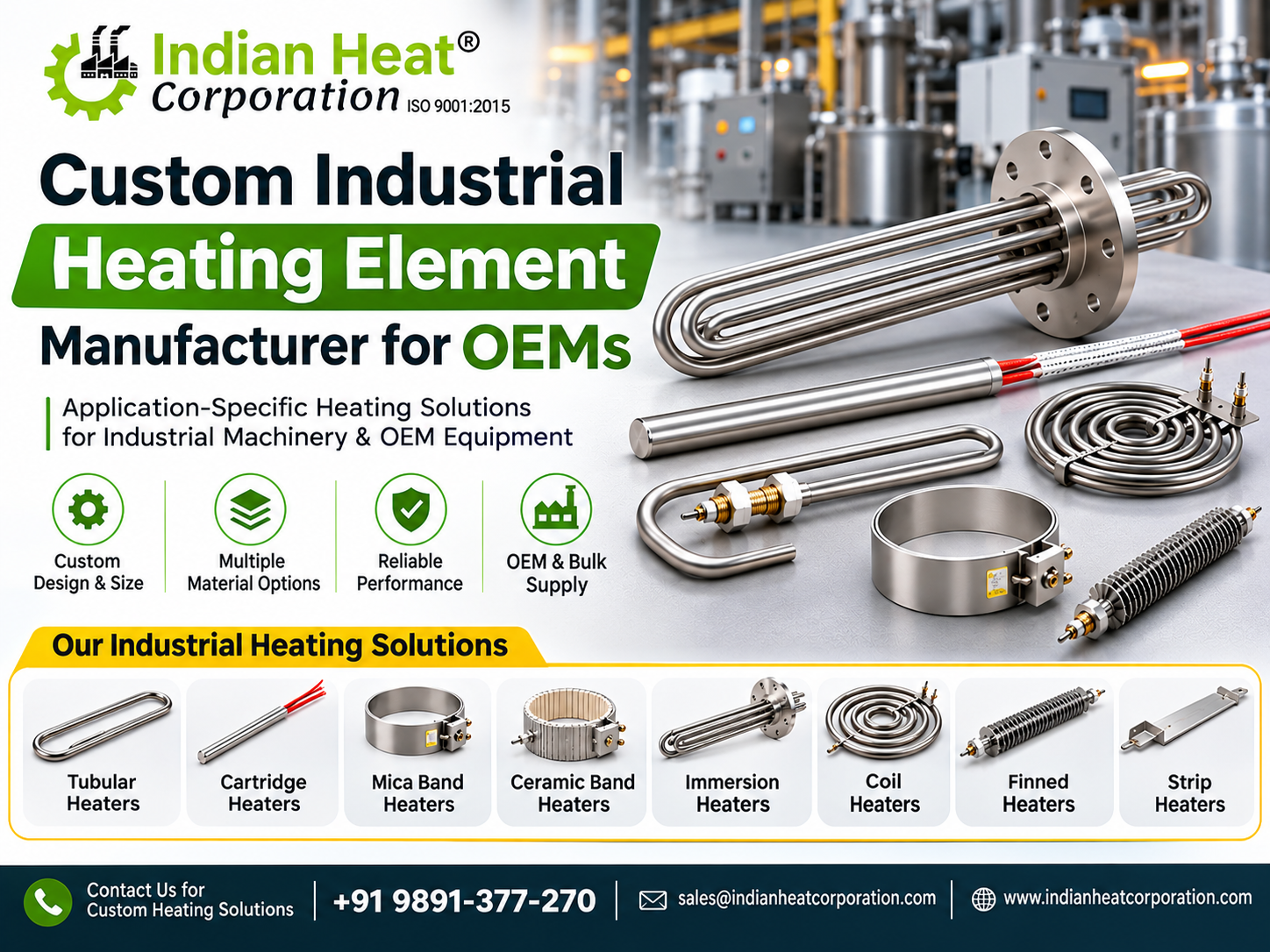
Indian Heat Corporation provides customized industrial heating elements for OEM machinery manufacturers, industrial equipment builders and process industries across India. Custom heaters can be designed around application requirements such as voltage, wattage, dimensions, shape, sheath material, insulation, heating zone, terminal configuration and mounting arrangement.
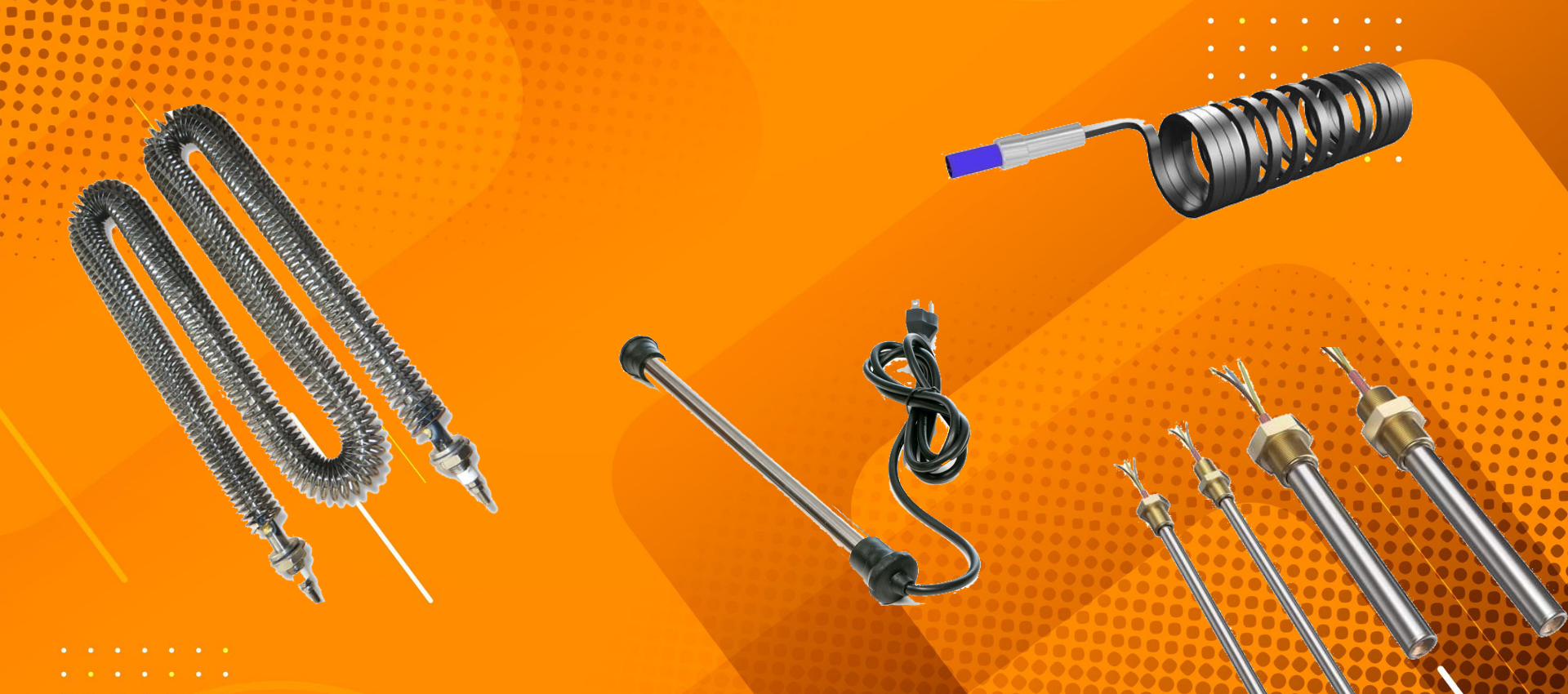
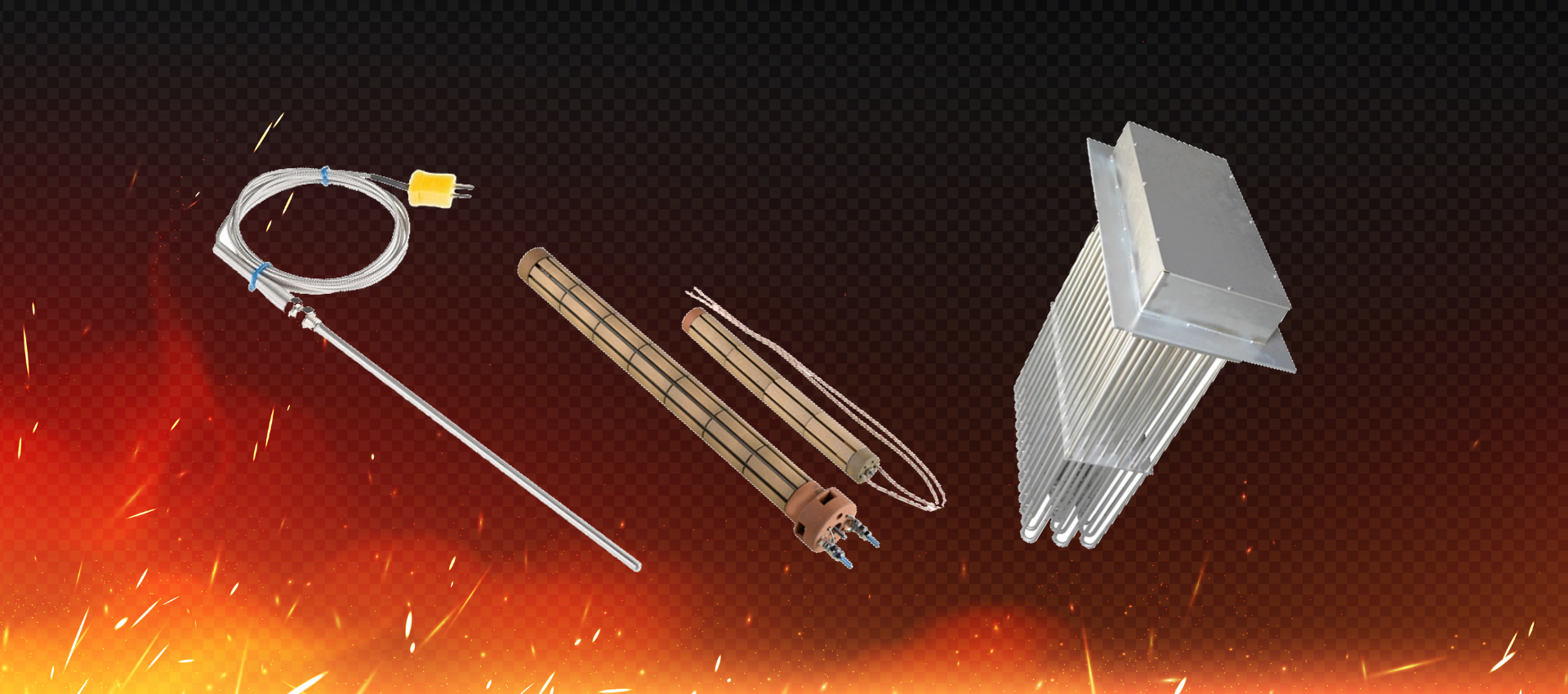
Our product range includes tubular heaters, cartridge heaters, mica band heaters, ceramic band heaters, immersion heaters, coil heaters, nozzle heaters, strip heaters, finned heaters and specialized industrial heating elements. These products serve plastic processing, chemical, pharmaceutical, food processing, packaging, textile, rubber, automotive and engineering applications.
If you are an OEM looking for a custom industrial heating element manufacturer in India, share your technical drawing, existing heater sample, machine details or specifications with Indian Heat Corporation for evaluation.
Custom industrial heating elements are electric resistance heaters designed to meet a particular machine's electrical, thermal, dimensional and installation requirements. OEM-specific designs may include customized voltage, wattage, length, diameter, shape, sheath material, terminal position, mounting arrangement and temperature-sensor provision.
Indian Heat Corporation provides customized industrial heating solutions for OEMs and industrial customers in India, including tubular, cartridge, band, immersion, coil and specialized heating elements.
An industrial heating element converts electrical energy into heat through an electrical resistance conductor. The generated heat is transferred to a material, liquid, air stream, surface or process component, depending on the heater design.
Custom manufacturing is useful when a standard heater does not match the machine's dimensions, required heat output, electrical supply, operating environment or installation arrangement. The design is developed around the actual application.
OEM machinery often has limited installation space and specific connection points. A custom heater can be designed to fit the available dimensions and mounting arrangement.
Required wattage depends on the material being heated, its mass, specific heat capacity, temperature rise, heating time, equipment thermal mass and heat losses. Heater selection should be based on the process rather than wattage alone.
The sheath and insulation must suit the heating medium, temperature, corrosion exposure and mechanical environment. Material compatibility is particularly important for liquid and chemical heating.
Approved drawings and documented specifications help OEMs reorder the same heater configuration for subsequent machine builds and replacement requirements.
Tubular heaters use a resistance wire enclosed in a metallic sheath with electrical insulation, commonly compacted magnesium oxide in mineral-insulated designs. They can be formed into different shapes for heating air, liquids, surfaces and process equipment.
Configurations: Straight, U-shaped, W-shaped, circular, finned, flanged and application-specific forms.
Applications: Industrial ovens, dryers, tanks, air heaters, water heating systems, oil heating systems and process equipment.
Cartridge heaters are compact heaters generally installed in drilled holes in moulds, dies, plates and machine components. Custom parameters include diameter, length, wattage, voltage, heated length, cold section, lead arrangement and terminal style.
Applications: Injection moulding machines, extrusion equipment, hot runner systems, packaging machinery, dies and industrial heating plates.
Mica band heaters are designed for cylindrical surface heating. They commonly use mica insulation and a metallic outer casing.
Applications: Plastic extruders, injection moulding machines, blow moulding equipment and cylindrical processing machinery.
Ceramic band heaters use ceramic insulation and are selected for suitable cylindrical heating applications, including processes requiring different thermal characteristics from a mica band design.
Immersion heaters transfer heat directly into a liquid. They may use screw-plug, flanged or other mounting arrangements. Sheath material and watt density must suit the liquid composition, circulation, temperature and operating conditions.
Applications: Water tanks, oil tanks, process vessels, washing systems and compatible chemical-processing applications.
Coil and nozzle heaters provide localized heating in compact spaces and are used in selected plastic processing and hot-runner applications.
Finned tubular heaters have extended surface area to support heat transfer to moving air. They are commonly integrated into duct heaters, industrial dryers and air circulation systems.
Strip heaters are used for surface and plate heating in machinery, packaging equipment, dies and other industrial assemblies.
Cast-in heaters are incorporated into a cast metal body to transfer heat through the component. They are used in selected plastic processing machinery, heating plates and specialized equipment.
Infrared and quartz heaters provide radiant heat for suitable surface-heating and drying applications. Silicone rubber heaters are flexible surface heaters used where a conformable heating arrangement is required.
Final specifications should be agreed after reviewing the equipment design and operating conditions.
| Parameter | OEM Requirement / Options |
|---|---|
| Heater type | Tubular, cartridge, band, immersion, coil, strip, finned or specialized |
| Voltage | According to machine electrical supply |
| Wattage | Calculated from process heating load and design conditions |
| Phase | Single-phase or three-phase, as applicable |
| Dimensions | Custom length, diameter, width and thickness |
| Shape | Straight, U, W, circular or application-specific |
| Sheath / body | SS304, SS316, Incoloy and other suitable materials, subject to application |
| Insulation | MgO, mica, ceramic, silicone rubber or product-specific insulation |
| Resistance wire | NiCr, FeCrAl or another suitable resistance alloy |
| Terminal | Screw, lead wire, ceramic terminal or customized connection |
| Mounting | Threaded, flanged, clamp or custom mounting |
| Temperature sensing | Thermocouple / RTD provision where suitable |
| Quantity | Prototype, production batch or repeat OEM requirement |
Note: These are design parameters, not a claim that every option is available for every heater type. The feasible combination should be confirmed after technical review.
For basic sensible heating, theoretical heat energy depends on the material mass, specific heat capacity and required temperature rise. Dividing this energy by the target heating time gives an initial power estimate.
Basic relationship: Power (W) = Mass (kg) × Specific Heat (J/kg·°C) × Temperature Rise (°C) ÷ Heating Time (seconds).
This estimate must be adjusted for heat losses, equipment thermal mass, insulation, airflow or liquid circulation, control strategy and process conditions. For immersion heaters, watt density and liquid movement are important considerations. For air heaters, airflow and outlet temperature are key design inputs.
SS304 is commonly used in general industrial environments where its temperature and corrosion characteristics suit the application.
SS316 may be considered where improved corrosion resistance is required. Suitability must be checked against the actual liquid or chemical, concentration and operating temperature.
Selected Incoloy alloys are used in demanding elevated-temperature applications where oxidation resistance and high-temperature performance are important.
Titanium and other specialized materials may be considered for particular corrosive environments. Material compatibility varies with concentration, temperature and process conditions.
Mineral-insulated tubular heaters commonly use magnesium oxide. Mica, ceramic and silicone-based insulation are used in other heater constructions. Nickel-chromium and iron-chromium-aluminium alloys are examples of resistance materials selected according to heater design and operating temperature.
Injection moulding and extrusion equipment may use mica band, ceramic band, cartridge, coil and nozzle heaters. Selection depends on barrel or nozzle dimensions, required temperature, machine supply and control arrangement.
Chemical plants may require immersion or tubular heaters for compatible liquids and process vessels. Chemical compatibility, circulation, sheath temperature and safe installation must be evaluated.
Drying, process and laboratory equipment may use tubular, cartridge or air-heating elements. Selection should account for process control, equipment design and material requirements.
Food processing equipment may use tubular, immersion, infrared or air heaters for suitable drying, baking, heating and packaging processes.
Packaging and sealing equipment may use cartridge, strip, coil or other compact heaters for controlled localized heating.
Drying, curing, moulding and component-processing machinery may use tubular, cartridge, band, infrared or other application-specific heating elements.
Oven and dryer OEMs may require tubular or finned tubular heaters selected according to chamber size, airflow, target temperature, heat-up time and operating cycle.
| Comparison | Standard Heater | Custom OEM Heater |
|---|---|---|
| Dimensions | Predefined sizes | Designed to specified dimensions |
| Electrical rating | Standard ratings | Selected for the application within design limits |
| Shape | Standard configurations | Application-specific where feasible |
| Terminals | Standard connection | Specified terminal arrangement |
| Mounting | Standard mounting | Machine-specific mounting requirements |
| Documentation | Product specification | Approved OEM drawing and specifications, where agreed |
A standard heater is suitable when its rating, dimensions and mounting match the equipment. A custom heater is appropriate when the machine or process requires a specific configuration.
The OEM shares the application, machine details, electrical supply, target temperature, dimensions, quantity and operating cycle.
The heating medium, heat load, watt density, material compatibility, available space and installation conditions are reviewed.
A suitable heater construction, sheath or body material, insulation and resistance alloy are selected for the application.
Dimensions, terminals, mounting details, heating zones and electrical ratings are documented for confirmation before production.
Operations depend on the product type and may include resistance wire preparation, insulation assembly, sheath or casing assembly, forming, terminal installation and finishing.
Checks may include resistance, insulation resistance, dimensions, terminal connections, visual inspection and application-specific performance checks.
The approved product is prepared for dispatch. Retaining the agreed drawing and specifications helps identify the correct configuration for future orders.
Inspection requirements depend on heater construction and customer specification. Relevant checks may include:
Testing methods and acceptance limits should be agreed according to applicable product requirements. Not every test applies to every heater design.
Indian Heat Corporation provides industrial heating elements and customized heating solutions for OEM machinery manufacturers and industrial users. Customers can share their application details, technical drawing or existing heater sample for evaluation.
The product range includes tubular, cartridge, mica band, ceramic band, immersion, coil, nozzle, strip and other industrial heating elements.
Heater requirements can be reviewed for dimensions, electrical rating, materials, terminals and mounting arrangements according to the intended application.
Indian Heat Corporation can evaluate new equipment requirements as well as replacement heater enquiries supported by samples, drawings or available specifications.
Heating requirements may come from plastic processing, chemical, pharmaceutical, food processing, packaging, textile, rubber, automotive and engineering industries.
Based in Delhi, Indian Heat Corporation receives industrial heating enquiries from customers in Delhi NCR and other industrial markets across India.
| Information | What to Share |
|---|---|
| Heater type | Tubular, cartridge, band, immersion, coil or other |
| Application | Machine name and heating process |
| Electrical details | Voltage, phase and required wattage |
| Dimensions | Length, diameter, width, thickness and mounting |
| Material | Required sheath or body material, if known |
| Temperature | Target operating temperature and heat-up time |
| Quantity | Prototype, batch or recurring production quantity |
| Reference | Drawing, sample photograph or existing heater |
If all specifications are not available, share the machine details and a photograph of the existing heater for an initial discussion. Final design and quotation remain subject to technical evaluation.
It is an electric resistance heater designed to meet a particular machine's or process's electrical, thermal, dimensional and installation requirements.
Indian Heat Corporation provides customized industrial heating elements and heater solutions for OEMs and industrial applications in India.
OEM drawings can be shared for technical review. Feasibility, final specifications and manufacturing details should be confirmed before production.
Common types include tubular, cartridge, mica band, ceramic band, immersion, coil, nozzle, strip and finned tubular heaters. The correct type depends on the application.
Useful details include heater type, voltage, wattage, dimensions, material, operating temperature, application, quantity and terminal or mounting requirements.
An existing heater sample, drawing or clear photographs can be submitted for evaluation. The available information must be sufficient to establish the required electrical and mechanical specifications.
Wattage is estimated from material mass, specific heat, temperature rise and heating time, then adjusted for heat losses and equipment conditions.
Material selection depends on the exact chemical, concentration, temperature and process conditions. Compatibility should be checked before specifying the heater sheath.
Cartridge heaters are generally used for localized heating inside drilled holes. Tubular heaters are formed into different configurations for liquid, air, surface and process heating applications.
Mica band heaters use mica insulation, while ceramic band heaters use ceramic insulation. Their suitability depends on required temperature, machine design and operating conditions.
Repeat requirements can be discussed using approved drawings and specifications so that the required configuration can be identified for subsequent orders.
Plastic processing equipment commonly uses band, cartridge, coil and nozzle heaters, selected according to the machine and heating zone.
They may be used for compatible chemical liquids, but sheath material, watt density, liquid circulation and installation must be evaluated for the specific chemical and process.
Depending on product design, checks may include resistance, insulation resistance, dielectric testing, dimensions, terminal inspection and heating performance.
Contact Indian Heat Corporation at +91 9891-377-270 and share the application, electrical details, dimensions, quantity and any available drawing or sample photograph.
Looking for a custom industrial heating element manufacturer for OEMs in India? Indian Heat Corporation can review your machinery and process requirements for tubular heaters, cartridge heaters, band heaters, immersion heaters, coil heaters and other industrial heating products.
For a technical enquiry, share your heater type, application, voltage, wattage, dimensions, material, operating temperature and required quantity. You may also share an existing heater sample or drawing for evaluation.
Company: Indian Heat Corporation
Business: Industrial Heating Elements & Custom Heating Solutions
Location: Delhi, India
Phone / WhatsApp: +91 9891-377-270
Email: info@indianheatcorporation.com
Website: Indian Heat Corporation
Request a quotation: Contact Indian Heat Corporation with your OEM heating requirements to discuss a suitable customized solution.
Custom industrial heating elements help OEMs integrate heating components that match the dimensions, electrical ratings, materials and operating conditions of their machinery. The right selection requires consideration of the heating medium, heat load, watt density, temperature, mounting and operating environment.
Indian Heat Corporation provides a range of industrial heating elements and customized heating solutions for OEM machinery manufacturers and industrial customers in India. Share your drawing, sample or application details to discuss the appropriate heating element for your equipment.